
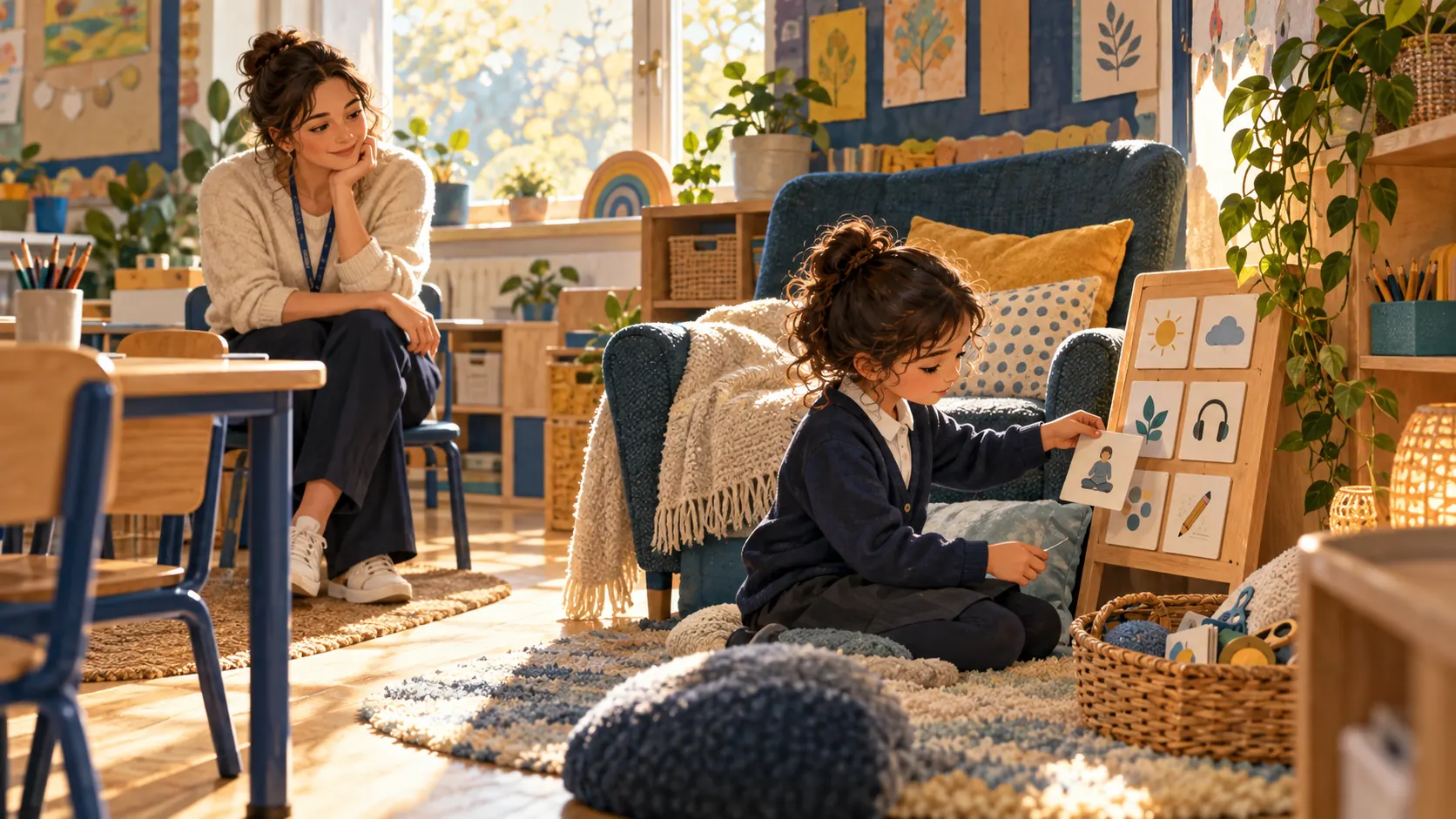
I’d agree with pupils what happens when someone needs a break, what the adult will do and how they can come back to the lesson. That’s the part I’d work out before buying cushions or equipment.
This practical guide explains how to create a calm corner in a classroom without turning it into a punishment area, a distraction zone or a substitute for understanding what a child needs. It is written for teachers, teaching assistants, SENCOs and school leaders and should be adapted to safeguarding, accessibility and individual support arrangements.
Begin with purpose, not shopping
Before choosing cushions or sensory tools, agree what the space is for. A clear purpose might be: “A place where a pupil can pause, choose an agreed strategy, get adult support if needed and return to learning.” That sentence includes the four essential parts—access, choice, support and return.
A calm corner should not be where a pupil is sent for being “naughty.” It should not be used to remove a child from peers because their distress is inconvenient. It is not clinical treatment, a seclusion room or a replacement for addressing bullying, inaccessible teaching, sensory overload or unmet SEND.
Ask pupils what calm means to them
One child may prefer to face the room so they know what is happening. Another may want less visual input. One may find a textured object helpful; another may hate it. Some pupils regulate through movement rather than sitting still. Invite ideas privately and offer manageable choices. Avoid asking children to disclose personal experiences in front of the class.

Design an accessible, low-clutter space
Location
Choose somewhere that can be supervised without the pupil feeling watched. Keep entrances and walkways clear. Avoid locations next to the noisiest equipment, a busy doorway or an adult workstation where private check-ins can be overheard. If a pupil cannot physically access the corner, create an equivalent option at their usual workspace.
Visual load
Calm does not have to mean beige, but too many posters, flashing lights and colourful objects can make the space harder to use. Start with a neutral background, comfortable seating and only a few clearly organised choices. Add items because a pupil uses them—not because they appeared on a “must-have sensory corner” list.
Possible resources
- a supportive chair, beanbag or floor cushion chosen with pupils;
- a simple feelings or needs prompt;
- two or three agreed tactile items;
- ear defenders where individually appropriate and hygienically managed;
- a visual timer if the pupil understands and accepts it;
- a short breathing, grounding or movement prompt;
- paper and drawing materials;
- a clear way to request adult help.
Consider cleaning, choking risk, allergies, breakage and safe storage. Schools should follow their own risk assessment and safeguarding procedures. A resource that looks therapeutic is not automatically appropriate for every child.
Keep it ordinary and dignified
A calm corner should feel like part of the classroom, not a cage or spectacle. Avoid labels that identify particular pupils. Make the basic routine available to the class while retaining individual adjustments for children who need them. This can normalise regulation without pretending everyone needs the same strategy.
Teach the routine when pupils are calm
Introduce the space to the whole class at a neutral time. Explain what it is, how to access it, which choices are available, how to request help and how to return. Model the routine briefly. Pupils should not have to become highly distressed before adults tell them what the space is for.
Create a simple sequence
- Notice or communicate that a pause may help.
- Use the agreed signal or ask an adult.
- Go to the space safely.
- Choose one support.
- Check in or return using the agreed route.
Some pupils can initiate this independently. Others need an adult to notice early signs and offer the option without turning it into an order. Language matters: “Would the calm space or a movement break help?” preserves more agency than “Go and calm down.”
Agree time without creating pressure
A timer can make a pause predictable for some pupils and threatening for others. If used, explain what happens when it ends. The answer should not be an automatic demand to leave regardless of the pupil’s state. It may prompt a quiet check-in: ready to return, need a different strategy, or need adult help?
Respond to distress before it peaks
A calm corner works best as one element of early support. Adults can learn individual signs that a pupil is becoming overloaded: increased movement, silence, repeated questions, changes in speech, covering ears, leaving work untouched or seeking reassurance. These behaviours are information. Offer support early rather than waiting for a crisis.
If a pupil is in acute distress, follow the child’s plan and school procedures. Reduce language, maintain safety and avoid gathering an audience. The calm corner may not be appropriate in that moment. It should never be treated as a guarantee that difficult situations will disappear.
Plan a dignified return to learning
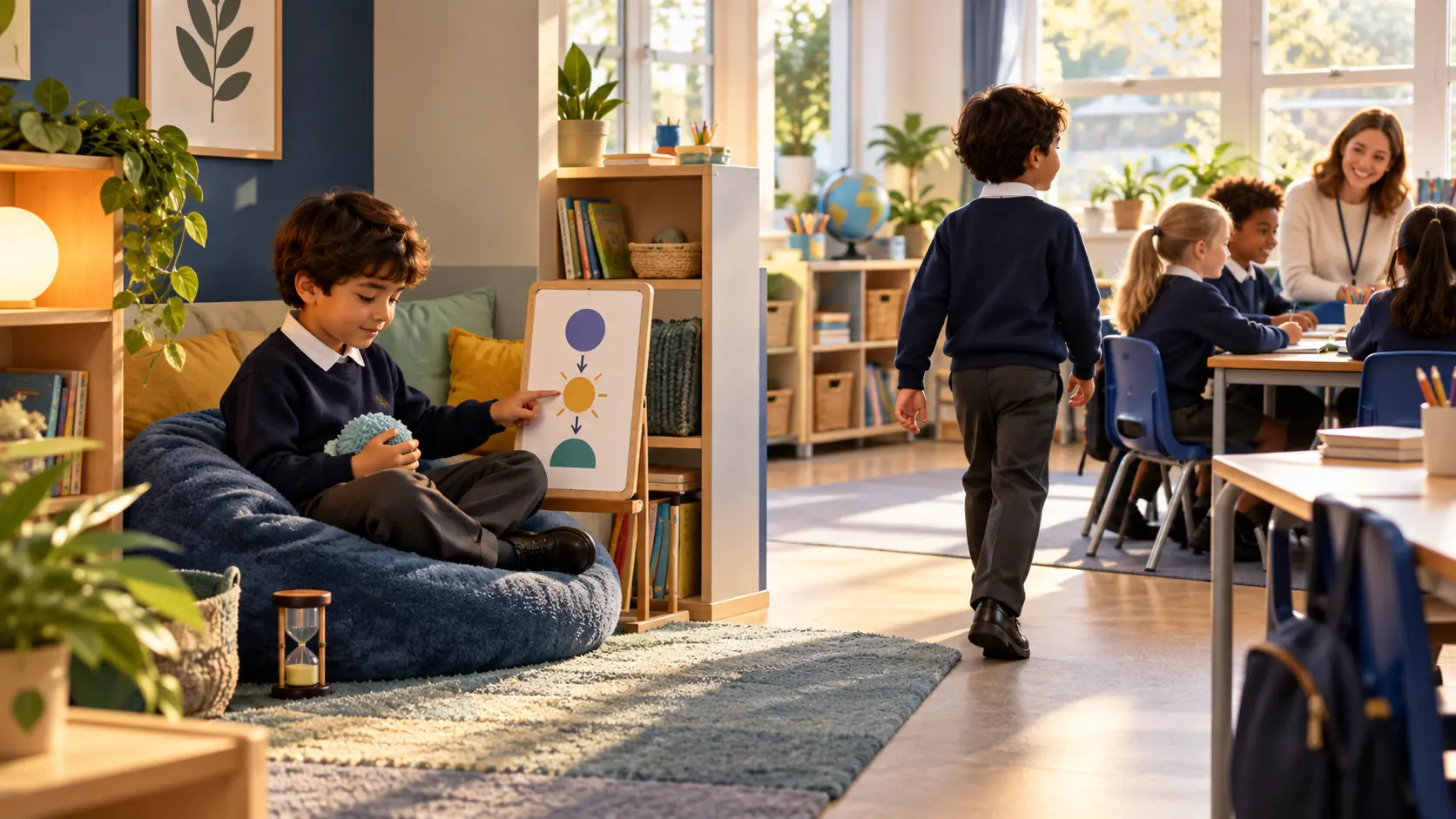
The return is often the missing part. A pupil who has paused may worry about walking back into a lesson, not knowing what they missed or being questioned publicly. Decide how an adult will give the next instruction, whether the pupil completes the original task, starts a smaller step or receives material later.
Keep the welcome back ordinary. A quiet “Your place is ready; we are on question two” can be more supportive than asking the child to explain themselves in front of everyone. Private reflection can happen later if useful. Do not require an apology merely for having been overwhelmed.
Do not let the corner replace support
If one pupil uses the space repeatedly during the same lesson, investigate the lesson. Is the work inaccessible? Are instructions too long? Is the room noisy? Is there a relationship problem? Does the child need a planned adjustment, movement, communication support or a different level of help? Repeated calm-corner use is data, not proof that the child is misusing it.
Review whether the calm corner is helping
After two to four weeks, gather the views of pupils and staff. Look beyond how often the corner is used. Useful questions include:
- Can pupils access it without shame?
- Do they understand the available choices?
- Are they returning to learning more successfully?
- Does it reduce or merely postpone distress?
- Are particular lessons, times or environments linked to repeated use?
- Can pupils who need physical or communication adjustments use an equivalent system?
- Are adults applying the routine consistently?
Remove unused objects. Replace confusing prompts. Move the space if the location is wrong. A calm corner should evolve rather than become a permanent display nobody evaluates.
How a calm corner fits a whole-school approach
Department for Education guidance describes mental health and wellbeing as a whole-school responsibility involving leadership, curriculum, staff development, pupil voice and targeted support. A calm corner cannot carry that responsibility alone. It is strongest alongside predictable routines, inclusive teaching, safe relationships, effective SEND provision and clear routes to pastoral or specialist support.
The Education Endowment Foundation also highlights universal inclusive approaches such as clear routines, explicit instruction, scaffolding and responsive teaching. A classroom environment becomes calmer when pupils can understand what is expected and access learning—not only when there is somewhere to retreat from it.
Common pitfalls to avoid
- Calling it voluntary but sending pupils there. Be honest about adult-directed safety responses and keep ordinary regulation support non-punitive.
- Overfilling the space. More sensory items do not automatically mean more support.
- Public monitoring charts. Do not display who used the corner or why.
- No route back. Plan the first step on return.
- One-size-fits-all rules. Individual plans may need different timing, location or communication.
- Ignoring patterns. Frequent use should trigger curiosity about barriers.
Further reading and sources
- Department for Education: Promoting and supporting mental health and wellbeing in schools and colleges
- Education Endowment Foundation: Universal approaches to inclusive teaching
- EEF: Special Educational Needs in Mainstream Schools
- SEND Code of Practice: 0 to 25 years