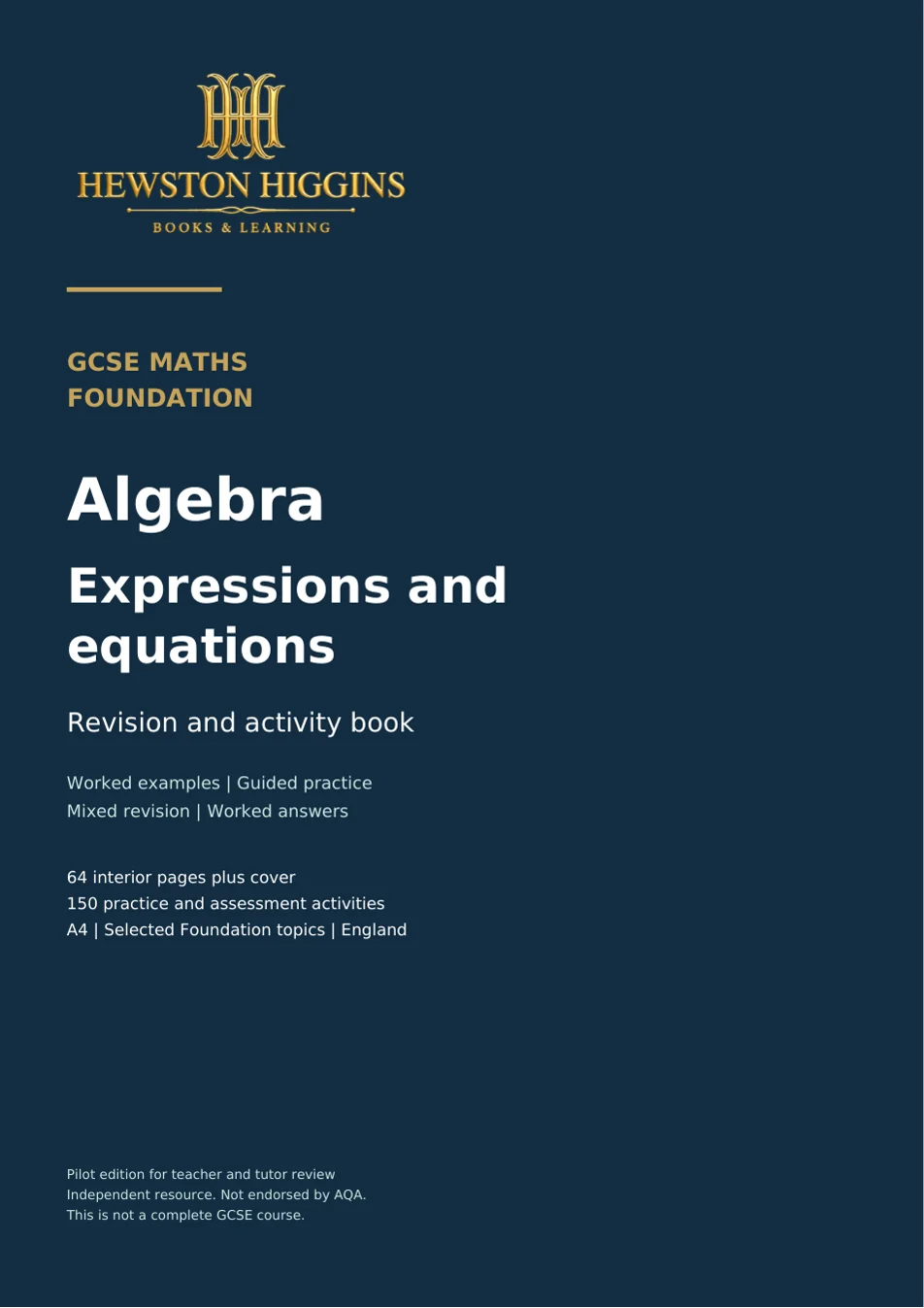
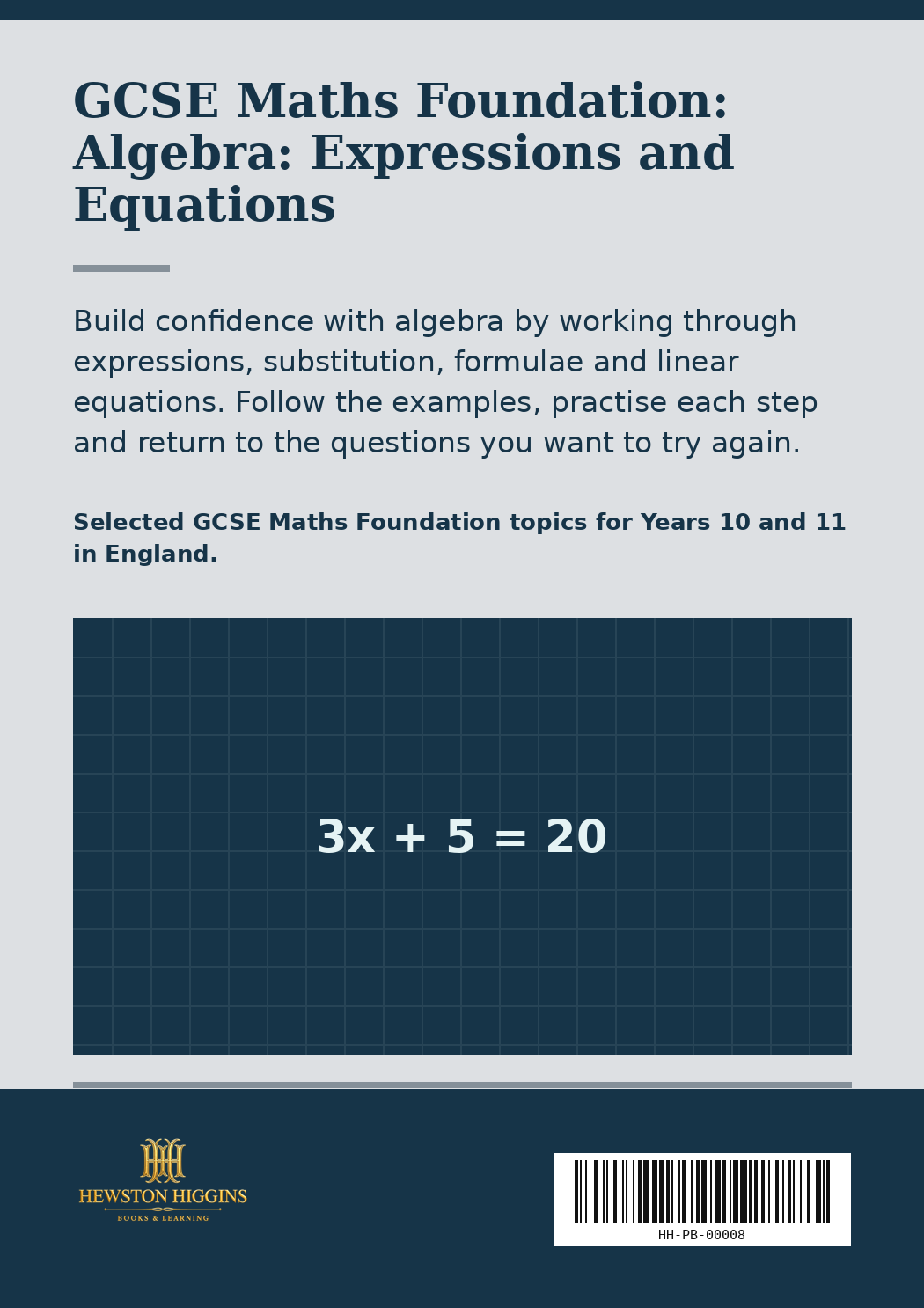
A selected-topic GCSE Foundation revision pack for England, primarily Years 10–11. Worked examples and guided practice cover notation, simplifying expressions, single brackets, substitution, simple formulae and linear equations, with worked answers for checking and revisiting methods.
Pilot edition. Prepared content and layout checks are complete; no independent subject-teacher review or classroom trial is recorded. This is a selected-topic resource, not a complete GCSE course, an official exam paper or a grade prediction. Independent material, not endorsed by AQA.
Inside the collection
Practice, guidance and classroom reminders
Revision and activity book
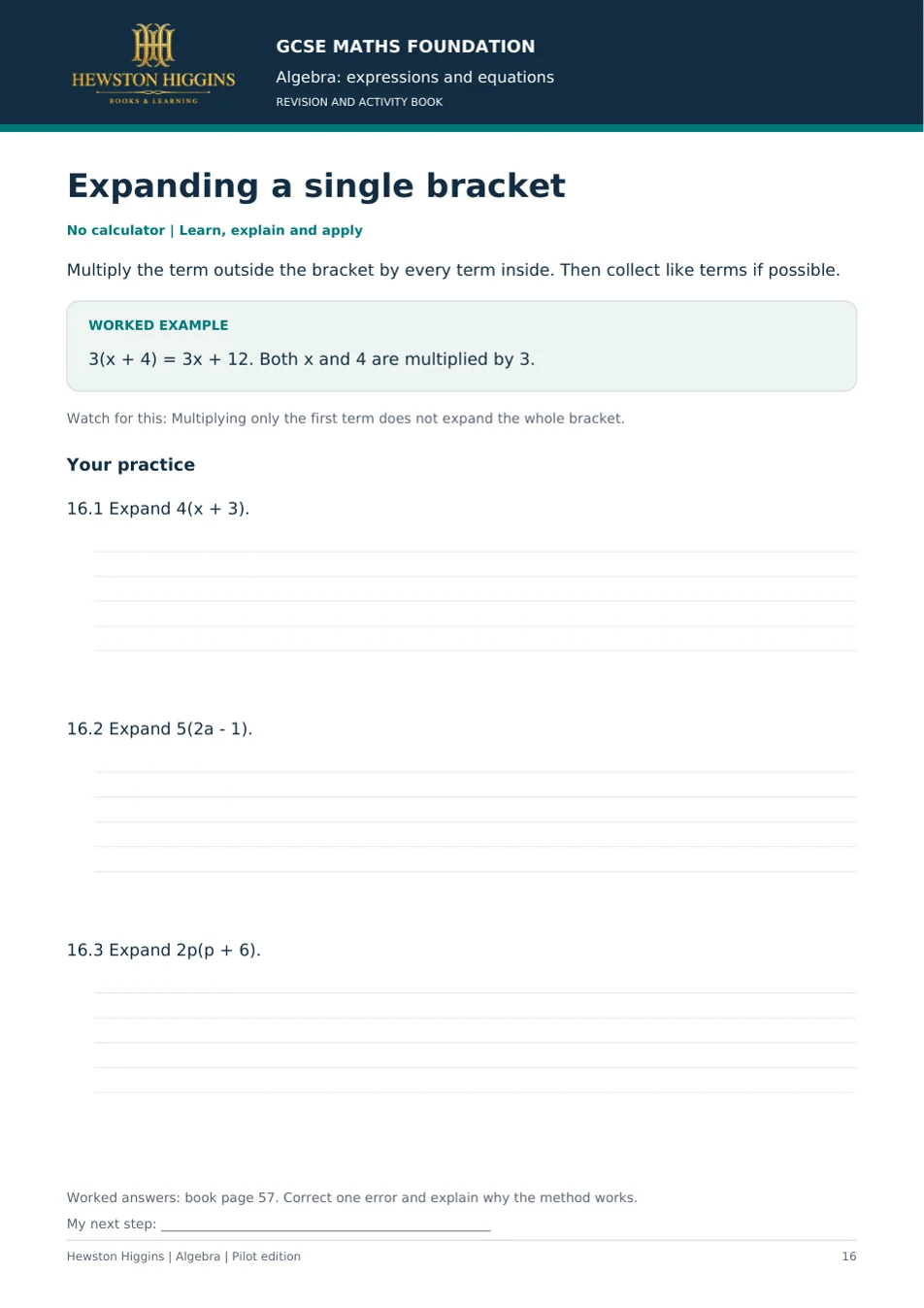
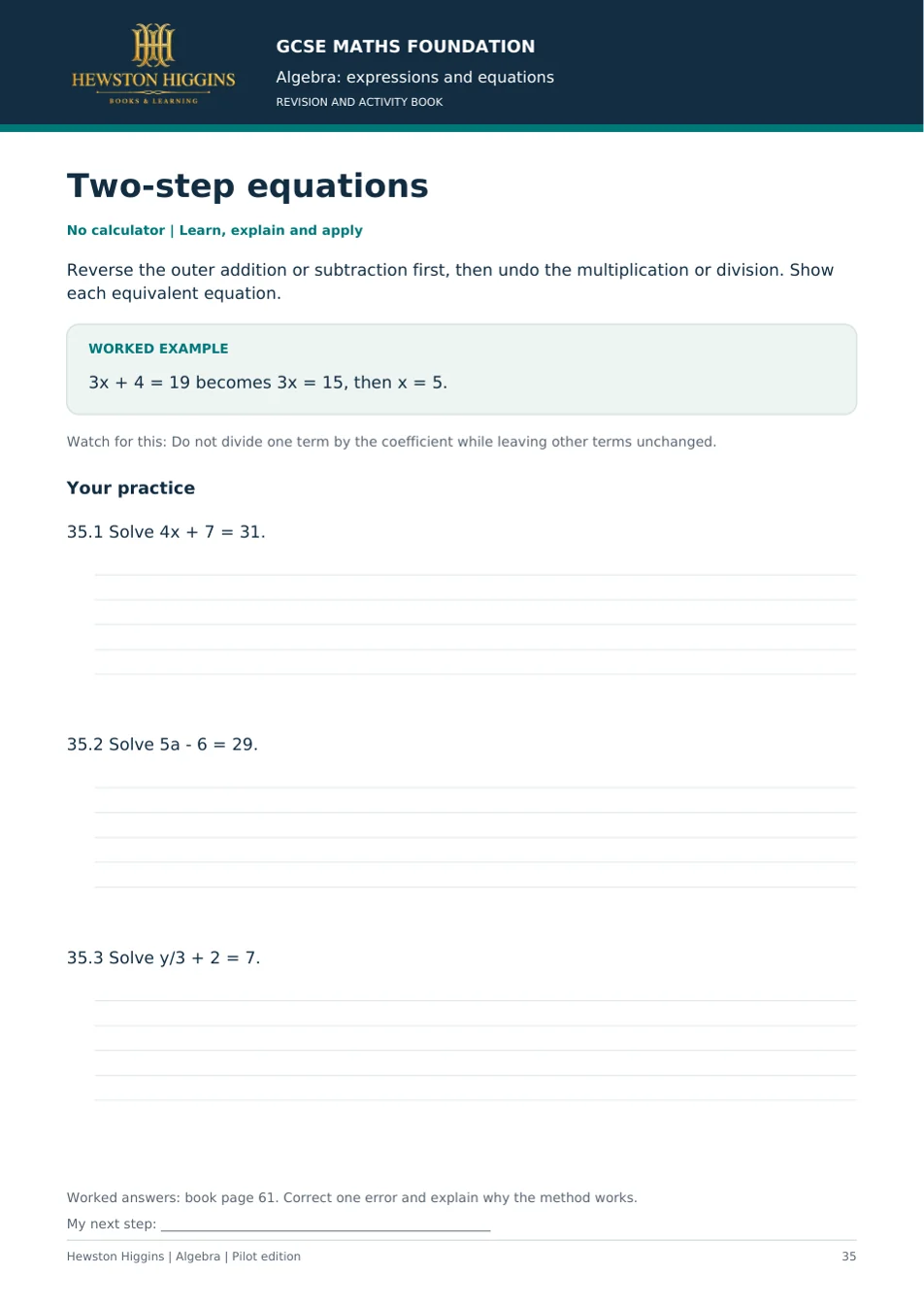
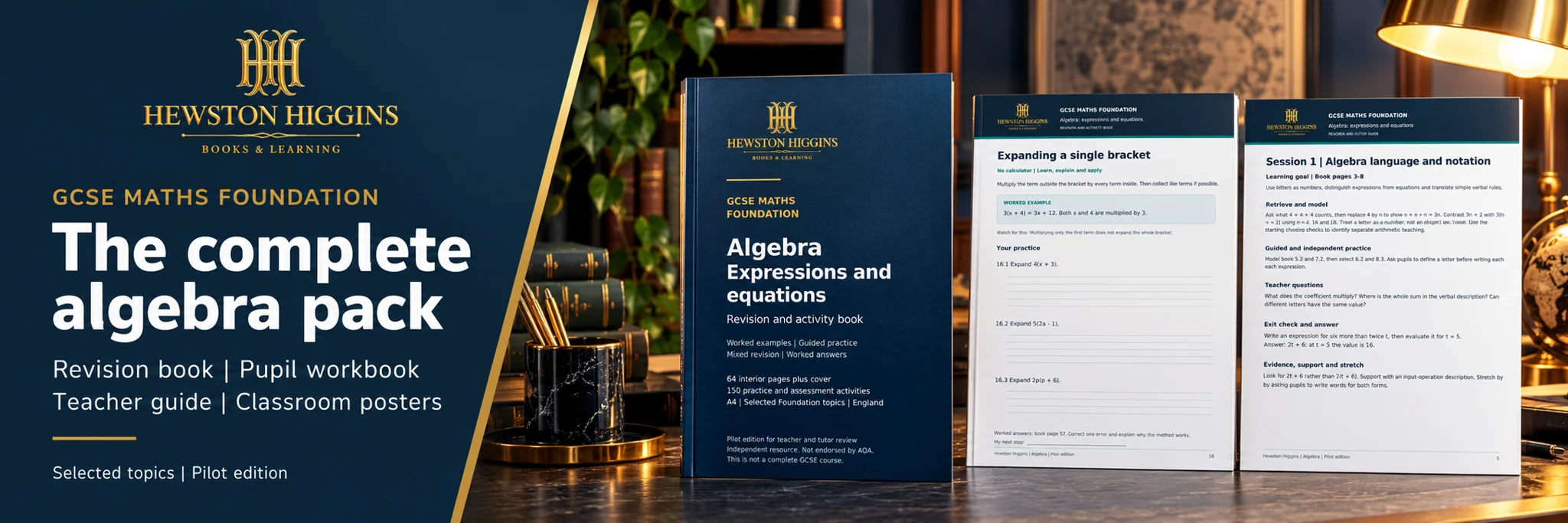
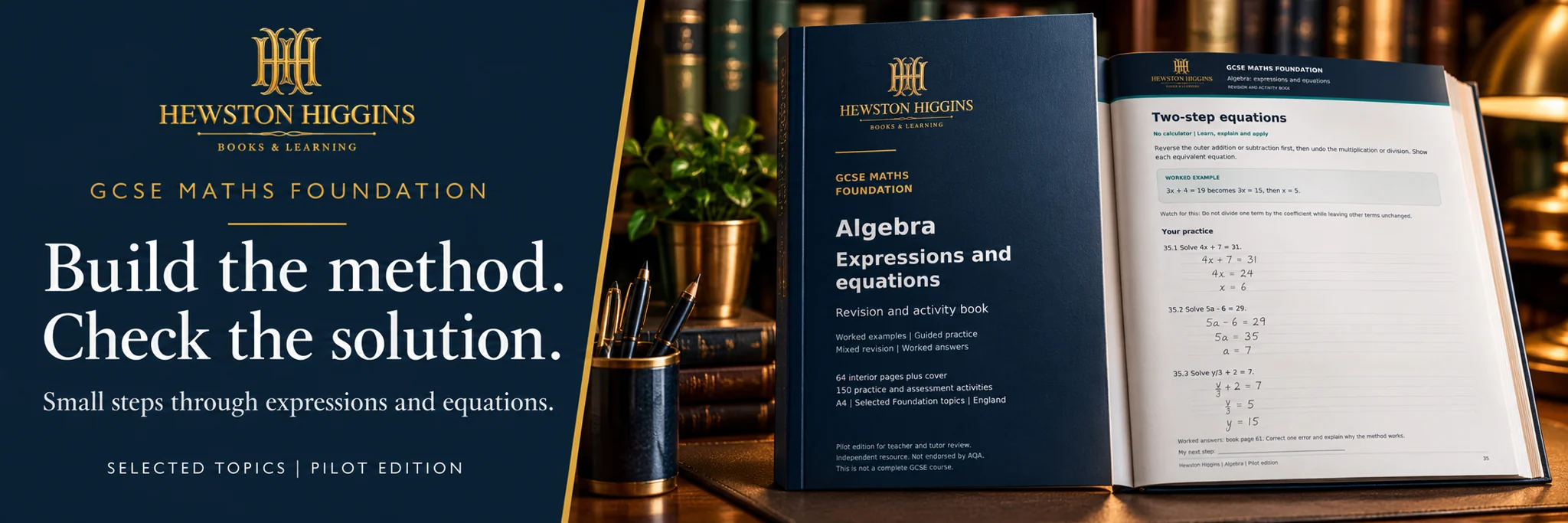
64 interior pages plus a cover: 65 PDF pages. Includes worked examples, guided practice, mixed revision, 150 practice and assessment activities, 12 short starting-check questions and ten pages of worked answers. Calculator guidance and question IDs help pupils work independently and find feedback.
Printable pupil workbook
52 A4 pages mirroring printed book pages 3–54. Keep the book on screen while pupils use matching worksheets. The workbook repeats these tasks rather than adding 52 pages of new activities; answers are in the revision book.
Teacher and tutor guide
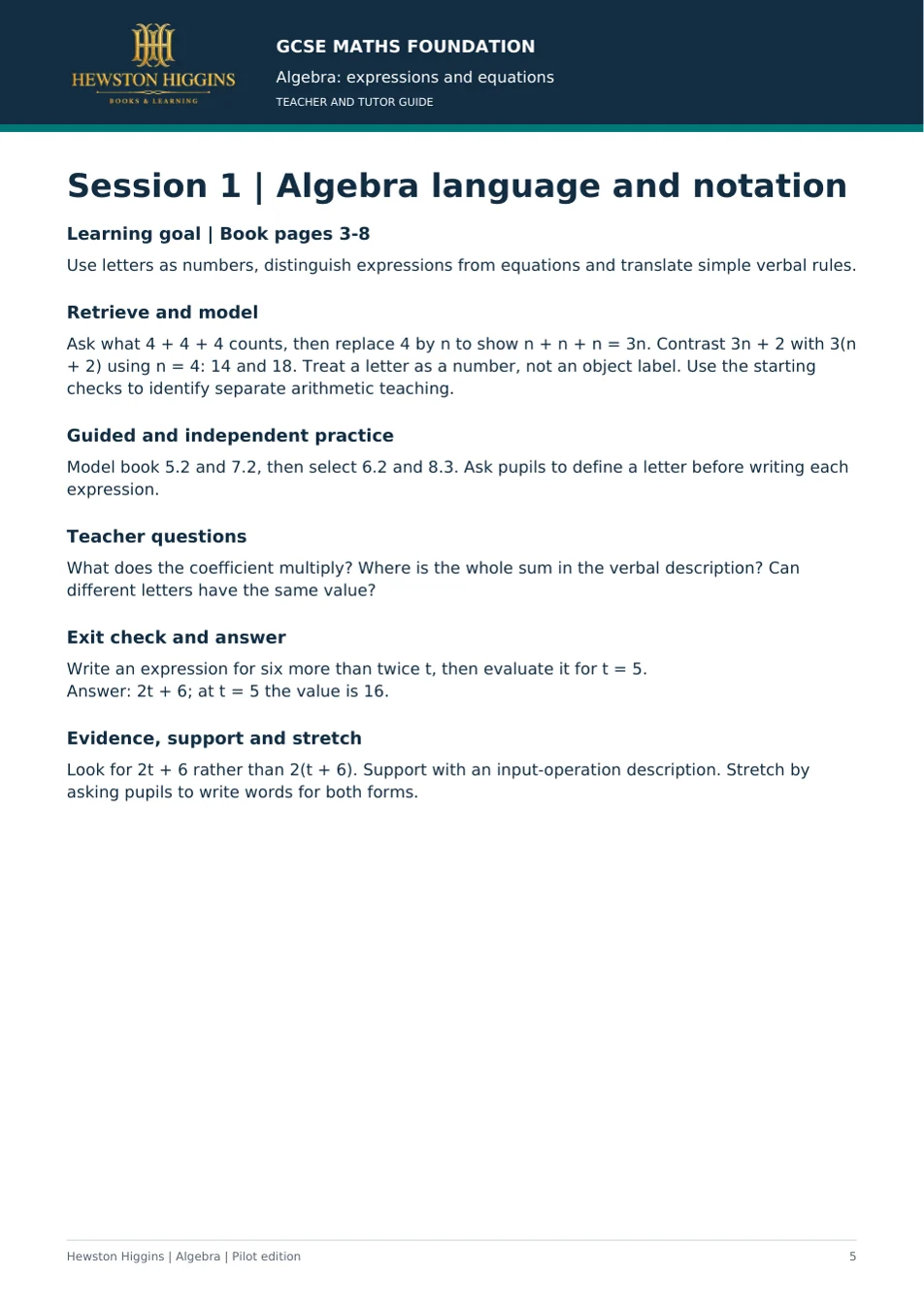
A 24-page PDF with a suggested sixteen-session route, topic-to-page mapping, prerequisites, common misconceptions, exit checks, marking guidance and access support. Adapt the sequence to the learner’s starting checks and available teaching time.
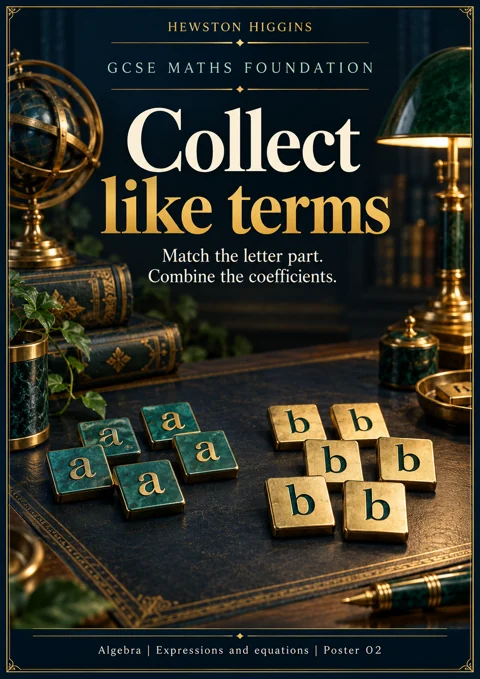
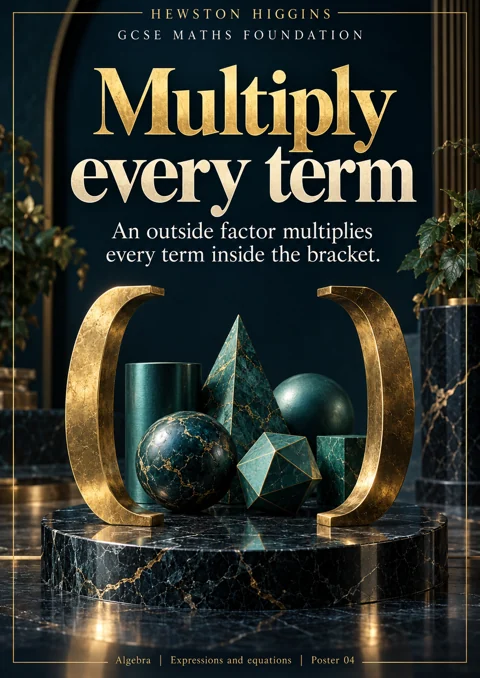
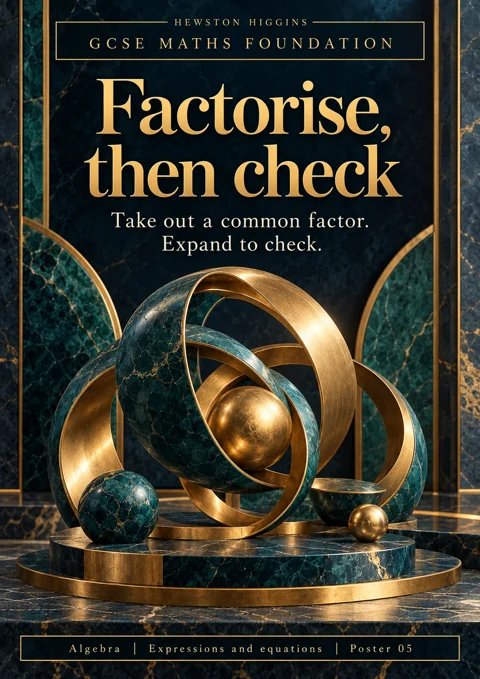
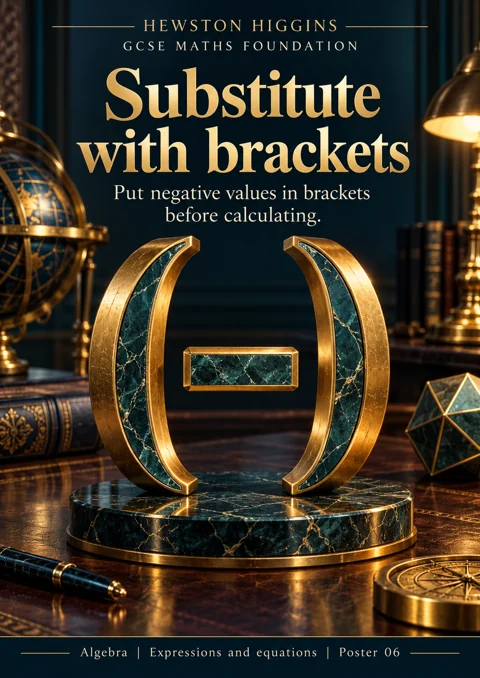
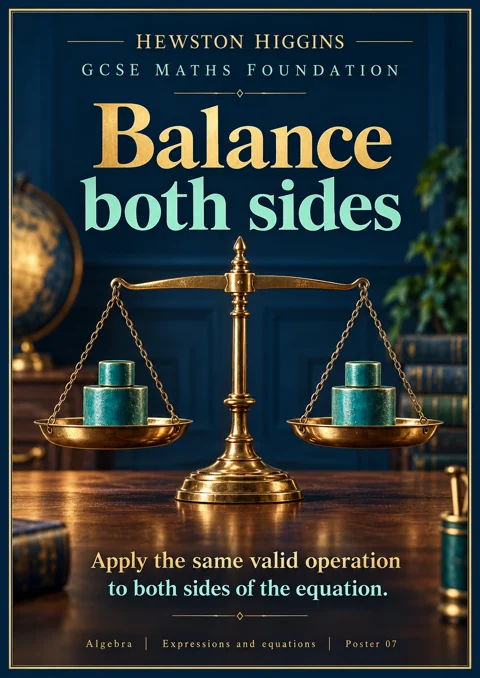
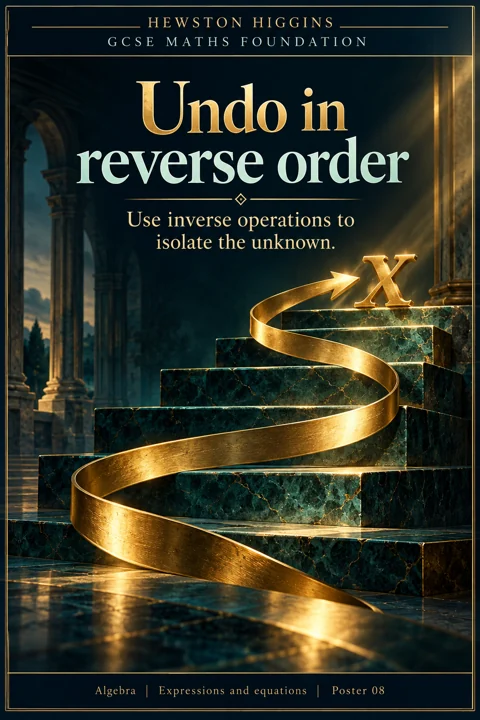
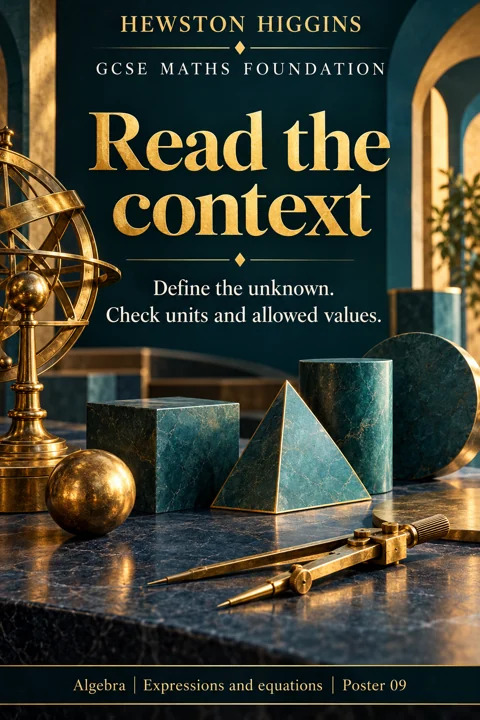
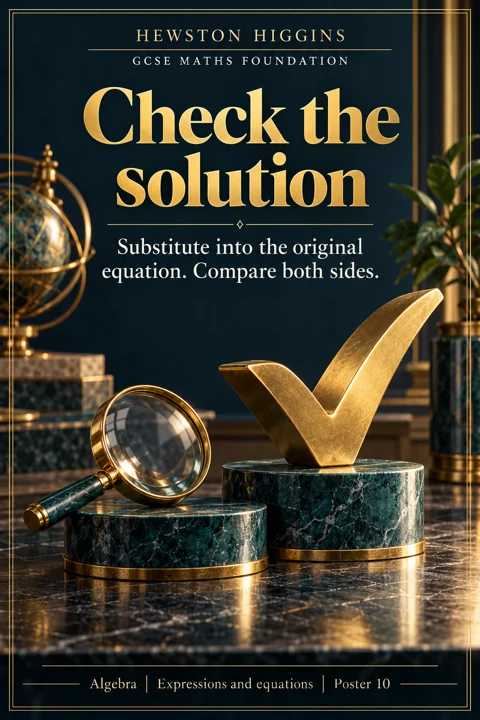
Ten classroom posters
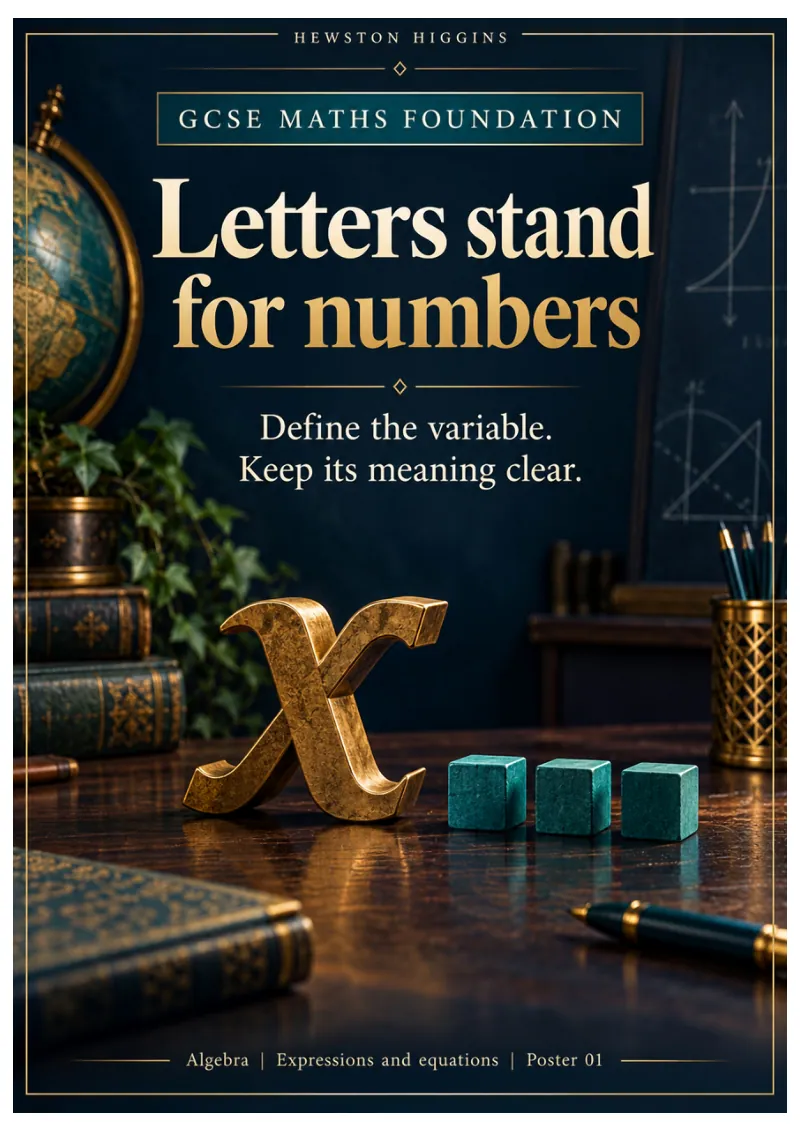
Ten complete image-generated designs with short method reminders built into the artwork. Supplied in two ten-page PDF collections, A4 and A3, for display alongside the revision tasks. Print the page you need at actual size.
A structured learning sequence for Key Stage 4
Designed primarily for Years 10 and 11, usually ages 14–16, working on selected GCSE Foundation skills. Teachers may also select prerequisite pages for older learners or targeted KS3 consolidation according to readiness. Start with the short checks, model a method, practise it, explain the reasoning, then revisit it in mixed tasks.
| Printed book pages | Learning focus |
|---|
| 1–4 | Study routine, algebra vocabulary and 12 starting checks |
| 5–10 | Letters, expressions, equations, notation, powers and operation order |
| 11–24 | Like terms, multiplying and dividing terms, single brackets, common factors, equivalence and perimeter |
| 25–31 | Substitution, geometry and cost formulae, changing the subject of simple formulae |
| 32–44 | Linear equations, inverse operations, negative/fractional/decimal coefficients, brackets and unknowns on both sides; solution checks |
| 45–48 | Forming and interpreting equations in number, perimeter and cost contexts |
| 49–52 | Mixed revision, explaining errors and choosing a method |
| 53–54 | Six assessment activities: 24 marks, calculator and no-calculator parts |
| 55–64 | Worked answers, starting-check answers and assessment marking points |
Printed book page numbers exclude the cover. The workbook uses the same question IDs; workbook page number equals matching printed book page minus two.
Sixteen suggested teaching sessions
The 24-page teacher guide offers sixteen sessions with learning goals, modelling, selected practice, teacher questions, exit checks and next steps. At 45–60 minutes per session, that suggests approximately 12–16 hours of supported teaching, with extra independent practice as needed. This is a planning estimate, not a tested completion time or a promise that every learner needs the same number of hours. A single practice page can be split into shorter blocks.
What students practise
Students define an unknown, preserve equality, choose a suitable algebraic method and check a proposed solution in the original equation. Practice moves from notation and numerical substitution into perimeter, costs and number models. Worked answers support correction after an attempt; the final topic check identifies a next teaching step rather than predicting a GCSE grade.
Which part of the curriculum does this algebra pack cover?
This resource supports selected algebra content for GCSE Foundation study in England, primarily Key Stage 4, Years 10–11, usually ages 14–16. It also revisits earlier algebra where learners need consolidation. The sequence builds from interpreting letters and expressions to manipulating expressions, substituting values, using simple formulae and forming and solving linear equations.
Selected AQA GCSE Mathematics 8300 connections
The teacher guide identifies partial connections to AQA 8300 Algebra: A1–A3 notation, vocabulary and substitution; selected A4 simplification, single-bracket expansion, common-factor factorisation and powers; selected A5 using and rearranging simple formulae; introductory A6 equivalence and identities and A7 input-output relationships; selected A17 linear equations, including some unknowns-on-both-sides work; and selected A21 contextual equation formation. These are partial connections, not complete coverage of each reference.
Coverage boundaries
This is an expressions-and-equations topic pack, not a complete GCSE course or complete algebra course. Two-binomial expansion, quadratic factorisation, general algebraic fractions with variable denominators, simultaneous equations, inequalities, sequences, coordinate graphs and quadratic solving require separate teaching. Some omitted topics also belong to Foundation; omission does not mean they are Higher-only.
Use the specification and teaching sequence followed by your school. This edition does not claim qualification alignment in Wales, Scotland or Northern Ireland. Independent material, not endorsed by AQA.
About this book and its learning purpose
A selected-topic GCSE Foundation revision pack for England, primarily Years 10–11. Worked examples and guided practice cover notation, simplifying expressions, single brackets, substitution, simple formulae and linear equations, with worked answers for checking and revisiting methods.
Learning opportunities
- Interpret and simplify an expression
- Substitute values and use a simple formula
- Solve a linear equation and check the solution
A practical way to use it
Use a starting-check question, model one method, attempt a matching pupil task and check by substitution. Return to the error before trying a similar problem.
SEND support and different ways to take part
Prepare vocabulary, use extra working space and split practice into short blocks. This is a pilot topic pack, with no independent teacher review or classroom trial recorded, and not a complete GCSE course.
Read the detailed teaching plan for GCSE Maths Foundation: Algebra: Expressions and Equations — preparation, three flexible sessions, accessible activity choices, learning observations and follow-up.
Teachers can share the book on screen where the edition and licence permit, and use matching printer-friendly activity pages where available.
Using the pack
1. Find a starting point
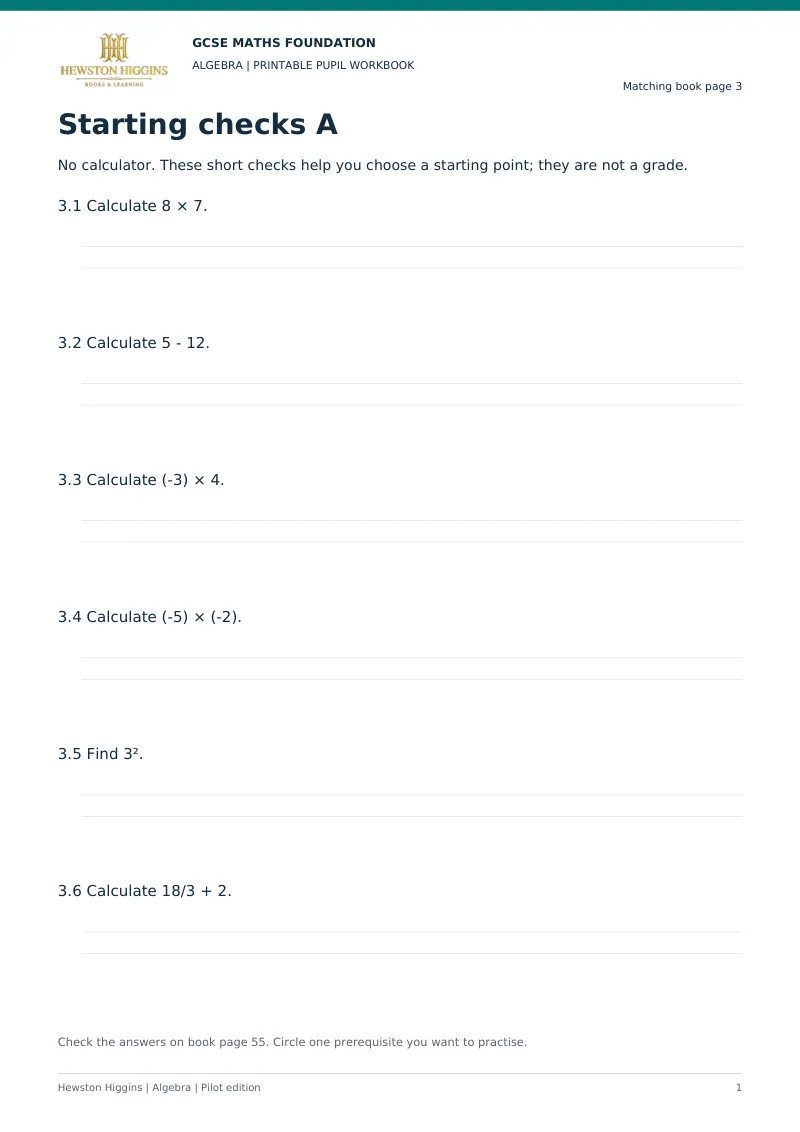
Use the initial checks to spot gaps in arithmetic, signed arithmetic, operation order and mathematical language. Choose the relevant pages with a teacher, tutor or supporting adult.
2. Practise and explain
Read the example, attempt the questions and show the method. Try a page in about 15–25 minutes or divide it into shorter blocks. Use extra working paper where helpful.
3. Check and revisit
Compare with worked answers after attempting the task. Correct a mistake, explain what changed and revisit a similar skill in a later session. Use the final topic check when ready.
Questions before downloading
Is this a whole GCSE revision programme?
No. It covers selected Foundation expressions-and-equations skills. Other algebra content, number, geometry, statistics and probability need separate teaching and resources.
Do the pupil sheets include answers?
No. The 52-page pupil workbook is designed for distribution without the answer section. Worked answers are in the revision book, included in the complete pack or available separately.
What file formats will I receive?
The book, guide and workbook are PDFs. The poster product is a ZIP containing an A4 PDF and an A3 PDF, each with ten pages. The complete pack is one ZIP containing all five PDFs. A PDF reader and a way to extract ZIP files are needed; no editable Word edition is included.
How should the files be printed?
Use A4 for the book, guide and workbook. Choose the matching A4 or A3 poster PDF, print at actual size and check printer margins. The poster art keeps its original proportions inside safe margins. Enhanced print artwork cannot recreate detail that was absent from the generated originals.
Has it been independently reviewed?
No independent subject-teacher review or classroom trial is recorded. This pilot is clearly labelled so teachers, tutors and families can judge its suitability. The assessment is a topic check, not an official examination or grade predictor.
More sample artwork