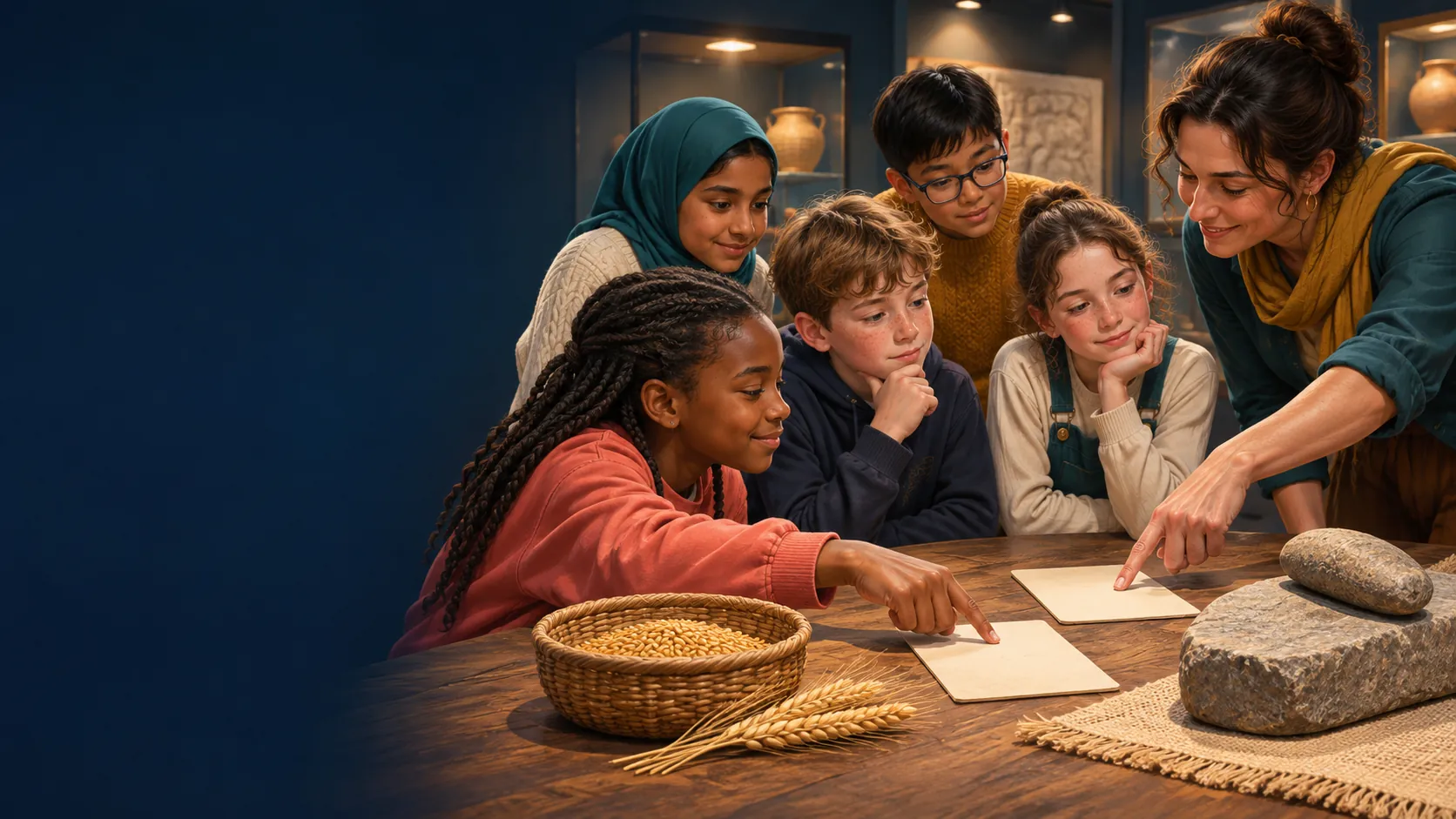
I’d ask children what they’d do with the grain if they already had enough for supper. Give them time to draw, talk, point to a choice or listen to what someone else thinks. Then see which ideas you can check with evidence.
This three-session sequence is for lower Key Stage 2, especially ages 7–9, with adaptations for home learning or a small group. It starts with a fictional story and moves towards a real archaeological site. The central question changes as children learn: first, why might this family save grain? Then, what can evidence tell us about people in the past?
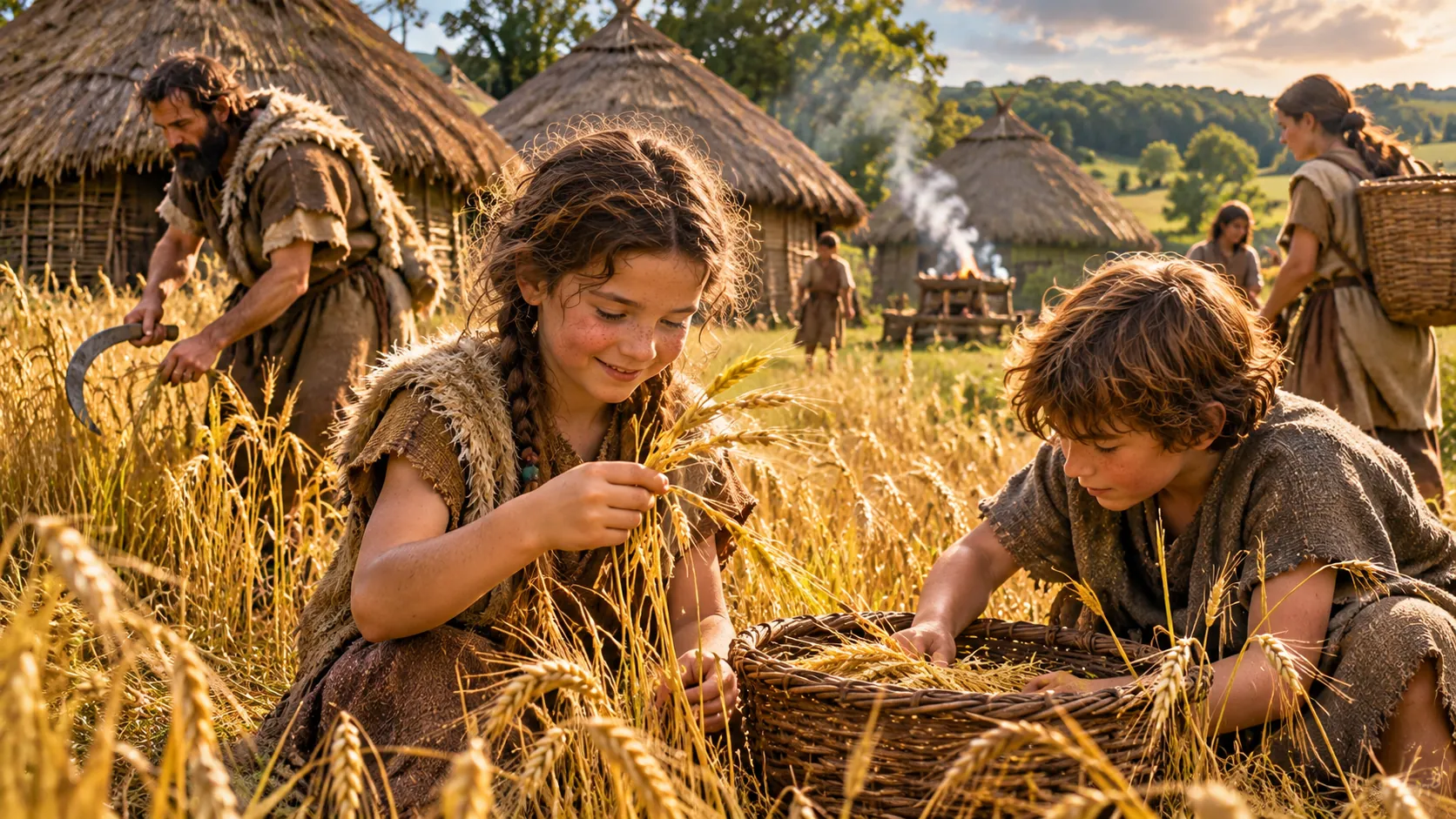
The starting point is the basket mystery described on the public page for The History Hoppers: The First Harvest. Rowan and Wren meet a family gathering a harvest from a new patch. Eda keeps a small basket away from the cooking pot. This is that family’s first harvest, not a claim to depict Britain’s first-ever harvest.
About this activity: the lesson sequence below is a newly written supplementary teaching suggestion. It does not reproduce the book’s original tasks or provide a printer-friendly companion. You can also use a suitable story you already have. The teaching choices are our practical suggestions; the historical and curriculum facts have linked sources.
What does this enquiry teach?
England’s history programme of study, published on 11 September 2013 and checked on 5 November 2026, includes Stone Age to Iron Age Britain at KS2. It also asks pupils to understand how accounts of the past draw on different sources. This activity contributes to those aims; three sessions will not cover the whole topic. Schools elsewhere in the UK can adapt the question to their own curriculum.
Keep the learning intention small: notice a detail, suggest an explanation and say what needs checking. Teach those steps explicitly. Children do not need to discover an entire prehistoric way of life from a picture. Give them the background knowledge and vocabulary needed to reason about a manageable question.
Before you begin: prepare one question and two kinds of material
Allow three sessions of about 35–45 minutes, or divide them into shorter meetings. Gather a story scene, paper, drawing tools and a source you have checked. Use paper grain symbols rather than loose food if that suits your group. There is no need for cooking, digging or handling sharp objects.
Prepare a simple record with three spaces: We notice / We think / We need to check. An adult can write while pupils point, speak, sign, type or use their usual communication system. Explain that the middle space holds possible explanations, not established facts.
For the real-world comparison, use English Heritage’s history of Windmill Hill. Read it yourself first, then choose a short, age-appropriate extract about the finds and possible uses of the site. Its discussion of burial practices may be unsuitable for your selected lesson; you need not show the whole page to children.
Windmill Hill is a Neolithic enclosure near Avebury in Wiltshire. Explain Neolithic as the later part of the Stone Age and locate the place on a map. Put the selected setting on your existing class timeline. English Heritage’s teaching prehistory guidance recommends breaking this long period into smaller parts. Avoid mixing every prehistoric tool, house and community into a single moment.
Keep the materials’ roles visible. The story is fiction. English Heritage’s text is a modern account drawing on archaeological investigation. An illustration helps us imagine a scene; it is not a photograph of prehistoric life. Check permissions before sharing book pages or reproducing other people’s images.
Session 1: become a careful story detective
Question: why might this family keep some grain? Read your selected story passage aloud, or introduce the basket puzzle in your own words. Offer time to look before asking for answers. Ask for one detail actually present in the material: a basket, a character’s action or a sentence the adult has read. Record it under We notice.
Model the difference between noticing and explaining. “The basket is set aside” describes the story situation. “Perhaps the family needs it later” proposes a reason. The second statement needs checking. If a pupil adds a detail that is not there, respond with “That’s a possibility. Shall we put it in our thinking space?”
Invite two or three explanations. Perhaps it is food for another day, a share for somebody else, or seed for a later crop. These are discussion possibilities, not facts about every prehistoric family. Let children choose between drawn symbols, offer another idea or say they are unsure. Avoid a guessing competition in which the first confident speaker settles the question.
Read on when appropriate and compare the story’s explanation with the group’s suggestions. The published book description connects the basket mystery with a future crop. Establishing the answer inside this invented story does not prove that the same event happened at a real settlement.
Exit check: ask each child to show one noticed detail and one possible explanation. A pupil might point to the basket and choose a “later” symbol. An adult can record the connection in a sentence. Keep the response method alongside the observation so you remember how the child showed their thinking.
Session 2: compare a story with a real archaeological account
Question: what can a real place help us check? Briefly revisit the story, then introduce Windmill Hill. Make clear that you are not claiming the fictional family lived there. The site provides a separate opportunity to investigate how people build explanations about the past.
English Heritage reports finds including flint tools, pottery fragments and animal bones. Its account describes several possible purposes for the enclosure, including gatherings involving animals and feasting. It leaves room for uncertainty. You can model careful language: “Finds can support an explanation without telling us everything that happened.”
Read your selected extract twice. First establish what was found. Next separate the finds from the suggested explanation. A simple example is animal bones were found alongside people may have gathered to feast. The first reports material evidence; the second interprets it. Do not ask pupils to identify a precise use from an unlabelled picture of an object.
Give pairs two spaces: In the story / At the real site. One pupil might draw the fictional basket; another might dictate that animal bones were found at Windmill Hill. Ask what is similar about the questions people are asking, and what the materials cannot establish. A story about saving seed and an account of animal bones are not interchangeable evidence.
For a more demanding response, ask: “Does this source tell us why Eda saved her basket?” The answer is no: Eda is fictional. That boundary matters. A vivid adventure can make a question memorable, while a checked source helps pupils learn what can be said about an actual place.
Exit check: record one thing the account reports and one question it leaves unanswered. Accept a short spoken answer, a selected card with an explanation, or an adult-scribed response. You are looking for a distinction between evidence and interpretation.
Session 3: put a historical claim on trial
Question: how far does our evidence take us? Present this deliberately overconfident claim: “Every family in prehistoric Britain lived in exactly the same way.” Tell pupils explicitly that it is a statement to investigate, not a fact to memorise.
Offer three responses: supported by what we have / not supported by what we have / we need more information. Agree what those choices mean before using them. “Not supported” does not automatically mean you have proved the opposite. A source about one site cannot establish how every family lived across a vast place and period.
Revisit your timeline, the invented family and the Windmill Hill account. Ask which parts of the claim cause difficulty. “Every” and “exactly” are useful words to examine. Does one story provide evidence about every community? Can the selected account describe all of prehistoric Britain? What additional places or periods might pupils want to investigate?
Now give a narrower statement: “Archaeologists found animal bones at Windmill Hill.” Children can check it against the named source. This contrast shows why the wording of a claim matters. One statement reaches far beyond your materials; the other can be checked directly. You are not teaching children to doubt everything, but to match confidence to evidence.
End with a short explanation using a frame if needed: “We can say… because… We cannot yet say…” Let pupils revise an earlier answer. Changing a view after reconsidering evidence is part of the task, not a failure.
Exit check: save one response and the reason behind it. A selected colour or tick alone can be ambiguous. If a child cannot explain in words, offer a choice of source details and invite them to show which supports their decision.
Make participation accessible without making the question smaller
Prepare vocabulary before discussion: grain, harvest, seed, source, evidence. Use a short explanation and a relevant image or object symbol. Keep the question visible, read it aloud and allow thinking time. Introduce one comparison at a time rather than displaying every material at once.
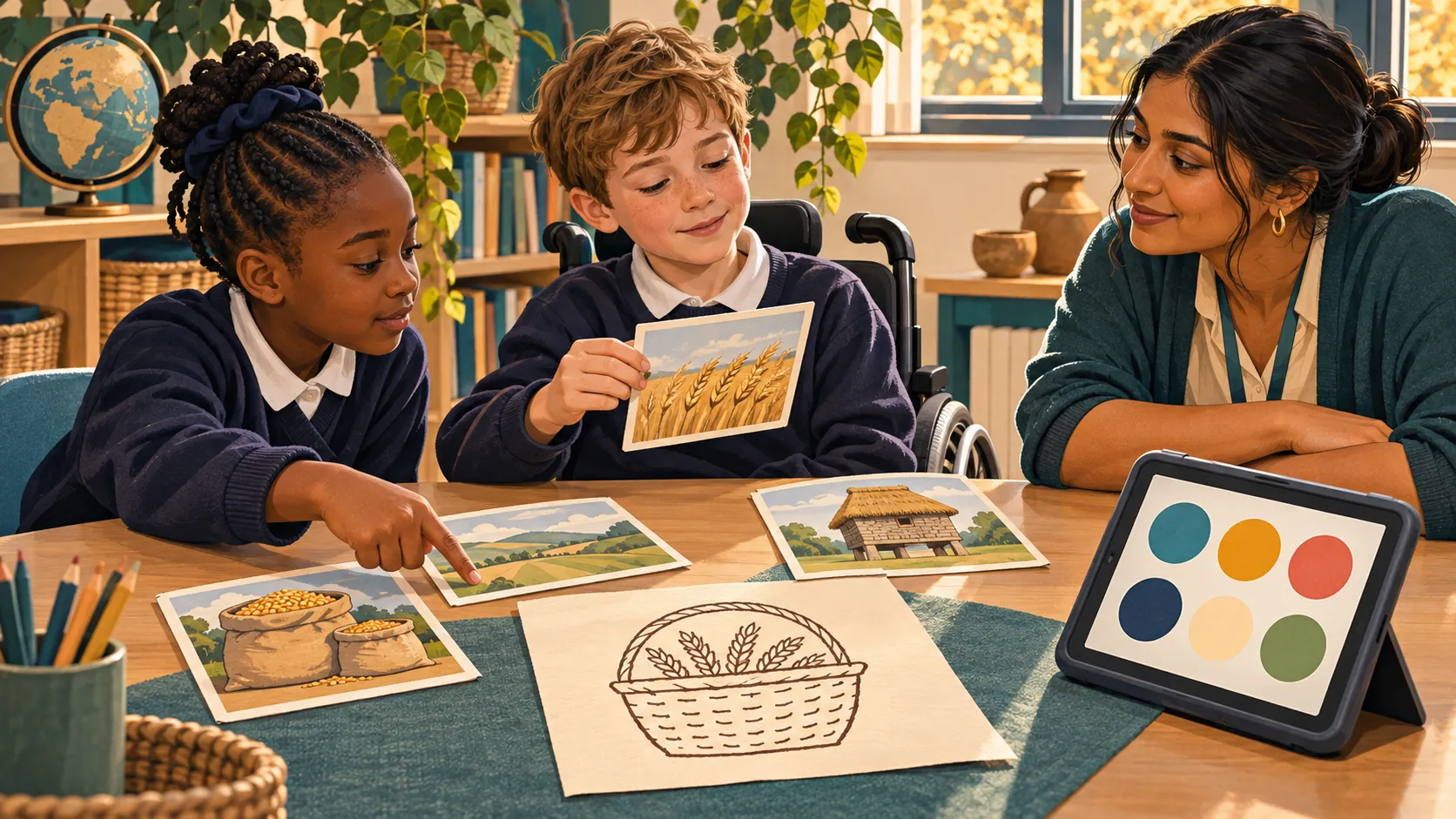
Offer genuine alternatives for recording. A child can arrange two pictures, point to a detail, use AAC, dictate a sentence or make an audio explanation. Follow their existing communication arrangements. Longer handwriting should not be the automatic route to a more challenging history question.
Avoid assuming that pupils with the same diagnosis need the same support. Notice whether the barrier is unfamiliar vocabulary, a busy picture, remembering several instructions or uncertainty about taking a turn. Adjust that part of the activity. For more ways to support participation, see our inclusive classroom communication ideas.
Extension can stay focused on historical reasoning: compare a second checked source, identify an unanswered question, or explain why a suggested interpretation remains uncertain. Children who need substantial reading support can still contribute a thoughtful comparison.
What should you look for afterwards?
Use three ordinary teaching observations: could the pupil identify a detail, distinguish a possibility from a source report, and recognise a limit to the available evidence? Note the support provided. These observations help plan the next lesson; they are not an assessment of a child’s SEND or a measure of a product’s clinical effect.
If pupils treat every illustration as proof, begin next time with two clearly labelled materials: an imagined scene and a real-site account. If they remember the basket but cannot explain the distinction, model it again with one sentence in each space. A smaller comparison may reveal more understanding than another worksheet.
Continue with The First Harvest
The History Hoppers: The First Harvest, Book Three, follows Rowan and Wren across prehistoric settings. Its public page describes 43 story-linked activities, with answers, for ages 7–9. Those original tasks belong to the book; this blog’s enquiry is an additional suggestion.
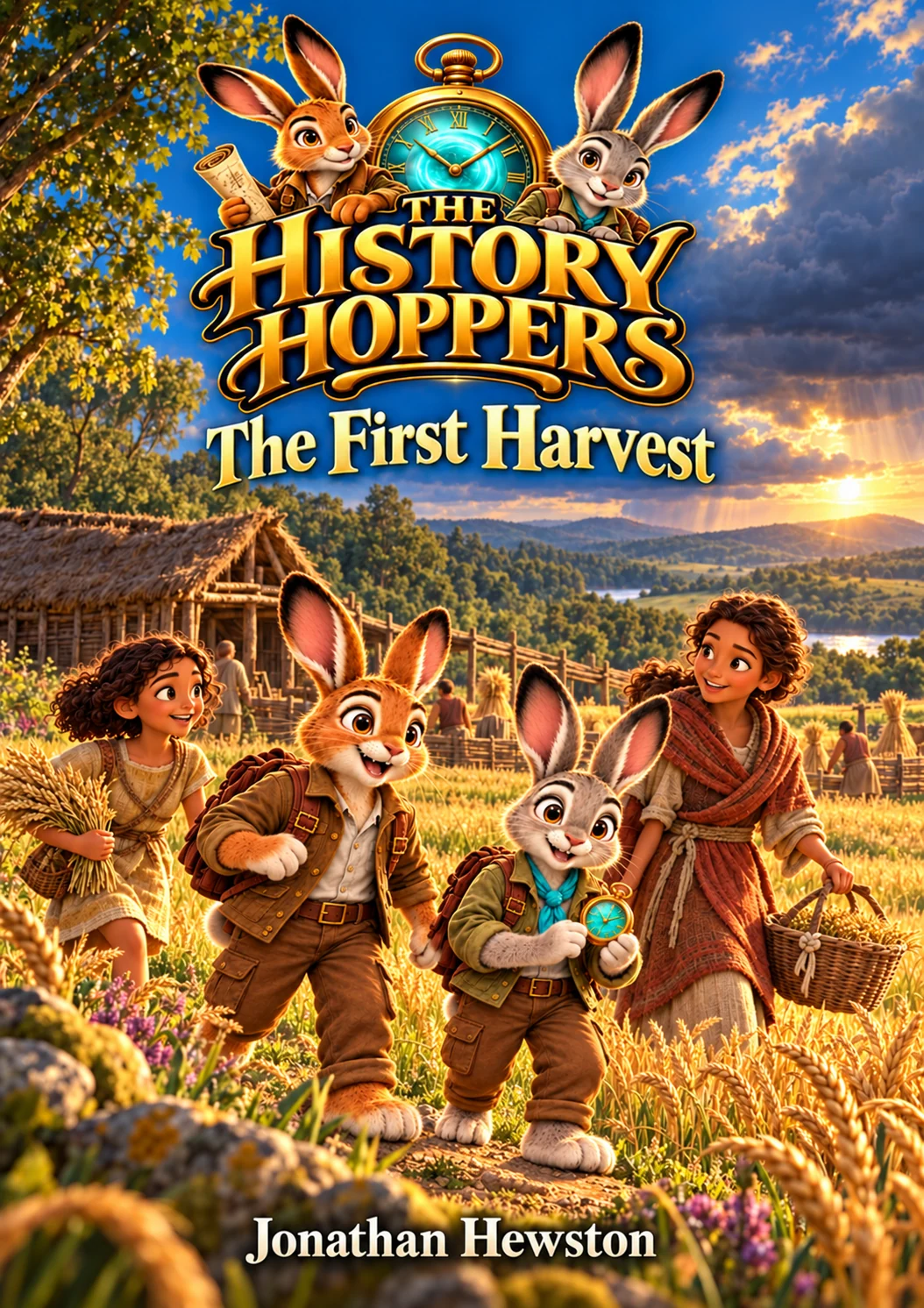
As checked on 5 November 2026, the title page lists the complete reading PDF for eligible School and School+ members under their licence and download allowance. The paperback remains in preparation, and the complete book is not offered there as a standalone PDF purchase. Check the current membership details before choosing a plan.
Start with the book’s public overview, or browse our practical learning guides. Choose the material that fits your next question. You can begin this enquiry with a story already on your shelf.
Sources and image notes
Checked on 5 November 2026: Department for Education, history programme of study for England; English Heritage, History of Windmill Hill and Teaching Prehistory. These sources support the stated historical and curriculum context, not independently measured outcomes for Hewston Higgins products.
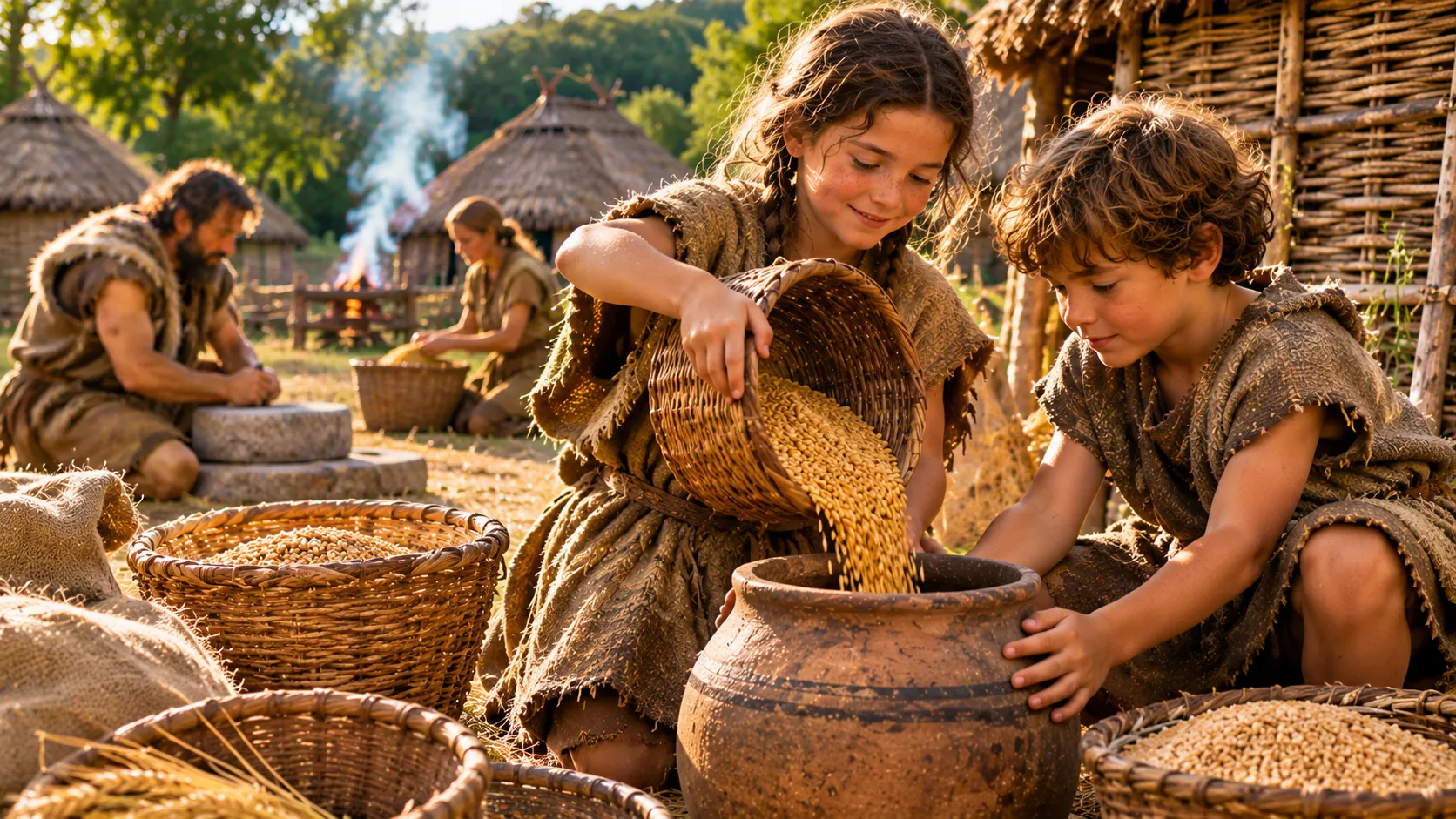
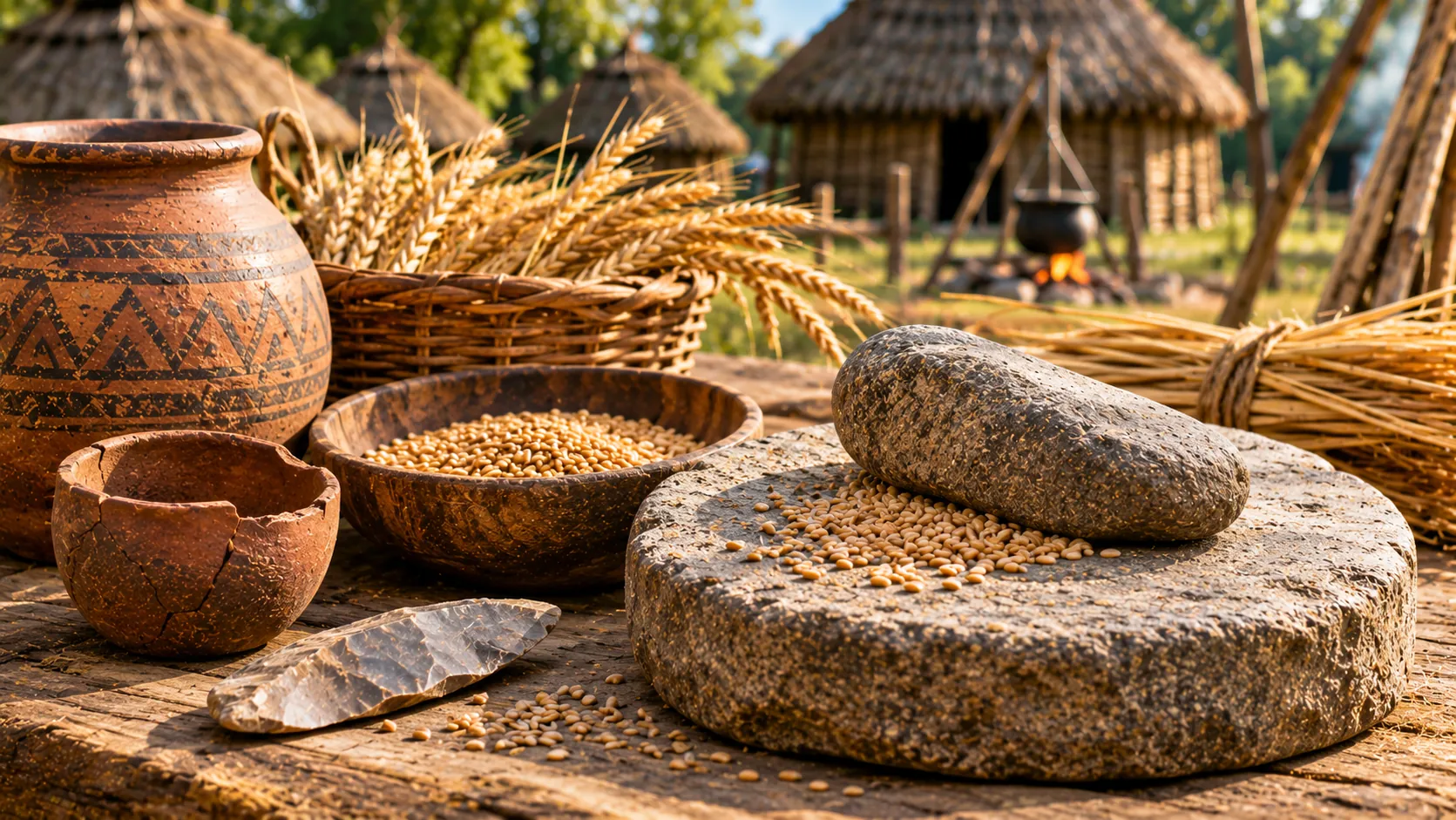
The editorial scenes are AI-generated illustrations. Imagined prehistoric scenes are not archaeological evidence: their buildings, clothing and objects should not be used to establish period-specific facts. Modern learning scenes are illustrative mockups, not photographs of real school use. The complete book cover is existing approved artwork.