
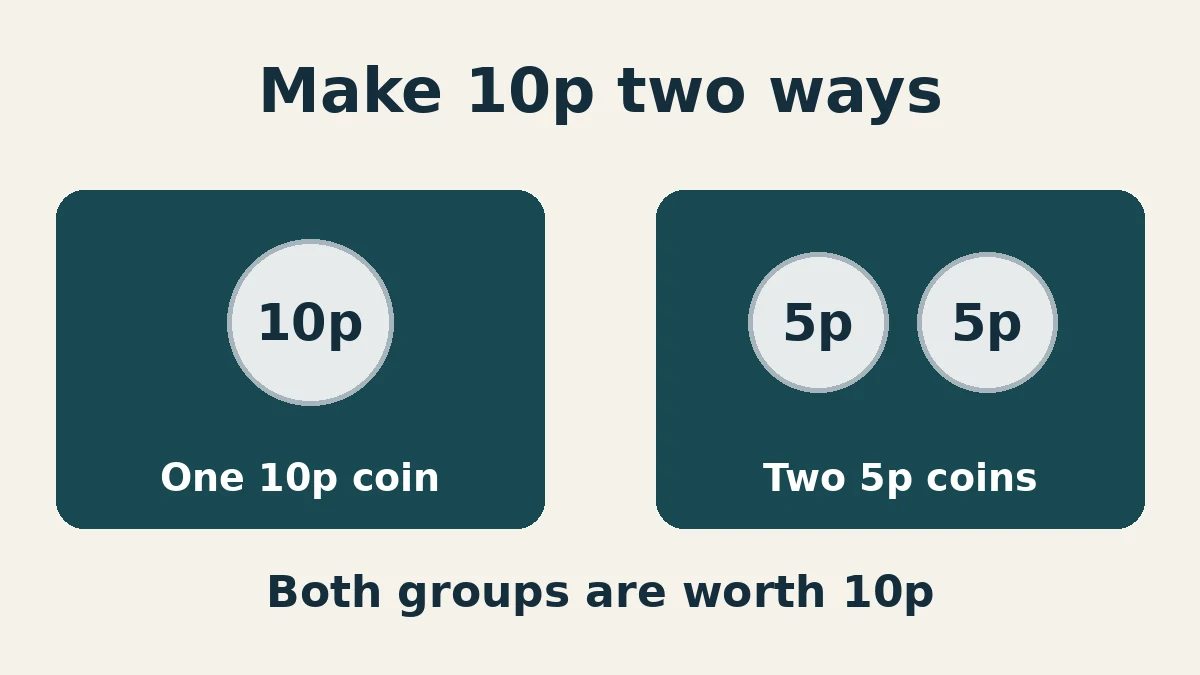
Put one 10p beside two 5ps and ask which tray has more money. If they choose the tray with two coins, ask them to say what each coin is worth. They’re already counting the objects. Now you can help them add the values.
This activity is for families, primary staff and anyone supporting a learner who needs a more practical route into money maths. It uses pence only and has one goal: show that the same amount of money can be made in more than one way. It is an original supplementary activity, not a page from a Hewston Higgins book or a printer-friendly companion.
What you need for a ten-minute money activity
Use two small trays or plain pieces of paper, one 10p coin, two 5p coins, and up to ten 1p coins if useful. Add a large card with 10p written clearly. You can use accurate classroom replicas or simple cards marked 1p, 5p and 10p. The cards are stand-ins for values, so use genuine coins or accurate replicas when the aim is recognising the coins themselves. Use the labelled diagram to compare values. Use genuine coins or accurate replicas to practise recognising each coin.
Start with the 10p and the 5p coins and leave the rest aside. A full purse adds a lot to look through before the child can begin. If small pieces are not appropriate, use large cards or let the child direct an adult to move the pieces. A non-slip surface, a quiet place to work or a clear edge around each group may make the setup easier to use. Ask what works rather than expecting all learners to prefer the same arrangement.
1. Separate the number of coins from their value
Place the 10p coin on the first tray. Say, “There is one coin. Its value is ten pence.” Put the two 5p coins on the second tray, with enough space to see each one. Point to them separately: “This is five pence. This is another five pence. Together they are ten pence.” Place the 10p card between the trays. You can show the same card beside each group in turn if that is easier to follow.
Ask ‘How many coins?’ first. Then ask ‘How much money?’ Give the learner time between the questions. They can say the answer, point to a card or show you with the coins.
If “two” comes up as the amount of money, acknowledge the part that is right: “Yes, there are two coins.” Then name the difference: “These are 5p coins, so we count five pence and five more.” Avoid turning that distinction into a trick question. Keeping the exact same objects in place lets the child see that the questions, rather than the coins, have changed.
| Tray | Number of coins | Total value |
|---|---|---|
| One 10p coin | 1 | 10p |
| Two 5p coins | 2 | 10p |
2. Connect the coins to something the learner already understands
If they’re unsure what 5p means, put five 1p coins beside one 5p coin. Count the pennies together and put a 5p label by each group. Repeat with a second set if it helps.
You could also draw two short rows of five marks. Explain that each mark stands for one penny in this drawing. Point to the first row as you name the first 5p coin, and the second row for the second coin. Ask the learner to show where the ten pence is in the drawing. If the marks are harder to read than the coins, keep using the coins. A drawing is a different way to show the same idea, not a compulsory next stage.
Notice which part of the task is difficult. A child may know that five and five make ten but mix up the coins. Another may recognise both values but lose track of which group you are asking about. Put the value card beside the relevant group, reduce the choice or use a familiar counting aid. Changing one thing at a time helps you see what made the task clearer.
3. Try one exchange in a pretend shop
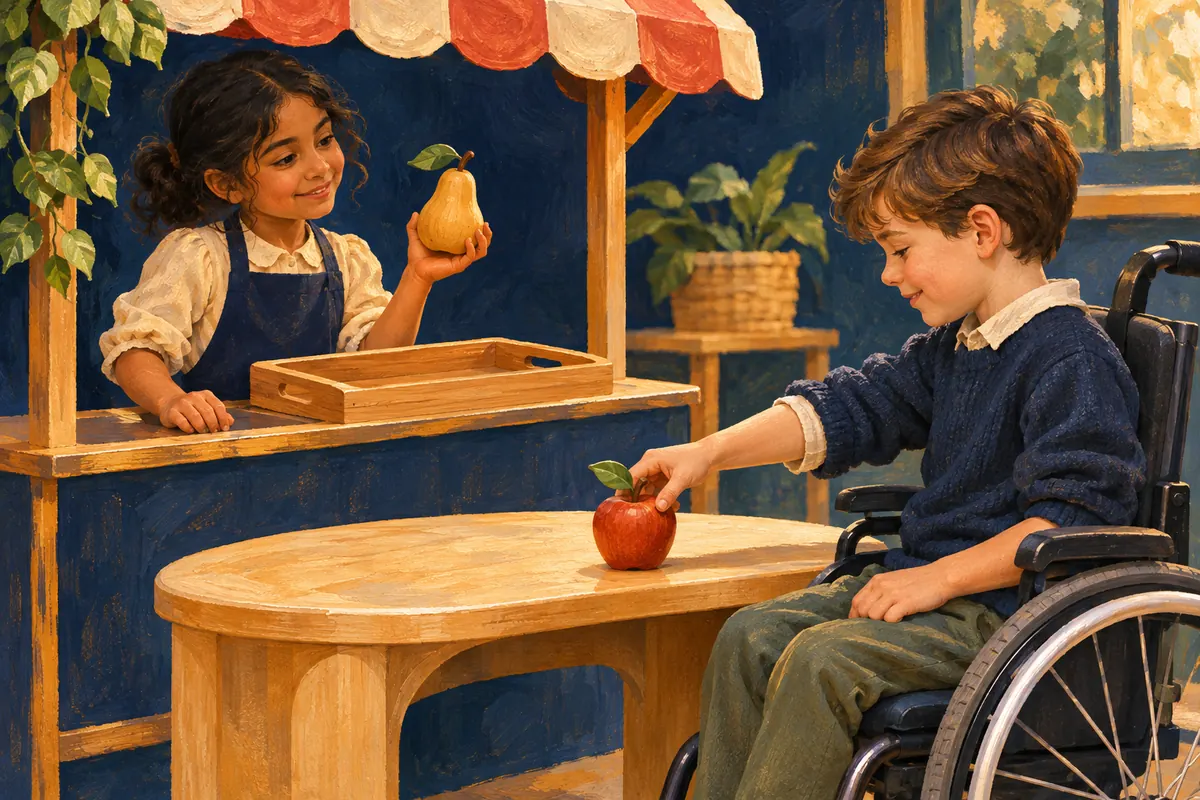
Pick one familiar object such as a toy apple. Set its pretend price at 10p. Offer two payment choices: one 10p coin or two 5p coins. Ask, “Can you pay exactly ten pence with either tray?” Let the learner choose. Then swap roles so the child can decide whether the adult has paid the amount. You can act as the shopkeeper together if speaking in role is an extra demand.
Keep the price at 10p while they try the different coins. Once they can show how both ways make 10p, you can try a new price or talk about change.
For an older learner, keep the same maths and change the context. Instead of a toy shop, use a neutral table task: “Make exactly 10p for this example.” Let them select a context or skip the role play. Practical maths should not feel like a reward reserved for younger children. If there is no cash available, value cards are enough for comparing amounts; be clear that they are not a coin-recognition test.
4. Record the idea without making handwriting the main task
Use a short record next to the objects: 5p + 5p = 10p. Read it while pointing to the coins and the total card, so the symbols have something concrete to refer to. A child can select a matching record, dictate what to write, take a photograph of their own tray if appropriate, or simply show the exchange again. A neat written line does not tell you by itself whether the child understood the equivalence.
One useful check is to ask the learner to move the same coins further apart. “Has the amount changed?” Compare the value before and after. Next swap the two 5p coins for a 10p coin. The number of coins changes; the amount of money stays the same. Leave both examples visible as long as needed. If the child gives the right answer but cannot explain it in words, ask them to show a match using the objects.
What to do if the activity is too easy or too hard
- If the values are unfamiliar: work on one comparison first. Match a single 5p coin to a clear 5p label before asking for a total. Repeat with different examples of a coin only when the learner is ready.
- If the learner can add but loses their place: keep each group on its own tray and move coins into a counted area as you go. A learner who prefers to direct somebody else can still choose what moves.
- If the answer depends on the way the tray is arranged: try the same amount with the coins rearranged. Check what they noticed before introducing new values.
- If the learner is ready to extend: ask for two ways to make 15p, using 10p and 5p or three 5p coins. Ask how they know both totals match. Finish with one clear comparison rather than a timed challenge.
At home, one successful match can be enough. In class, write down what the pupil showed, such as ‘Matched two 5p coins to 10p with the value cards visible.’ That tells the next adult where to start.
Where this fits in the curriculum
The Department for Education’s mathematics programme for England includes recognising the value of denominations in Year 1 and combining amounts and finding equivalent coin combinations in Year 2. This one activity addresses a small part of that progression. If you teach elsewhere in the UK, use the relevant local curriculum and the learner’s starting point.
The Education Endowment Foundation’s early maths guidance emphasises helping children connect a moveable object with the maths it represents. Here, that means pointing from a coin to its value and showing why the total does not change when the coins are exchanged. The guidance informs the approach; it does not establish a measured effect for this specific activity.
For more ideas using familiar objects, see everyday maths at home. For wider learning materials, explore the Hewston Higgins KS1 maths resources or compare current membership options. You do not need a membership or a purchased resource to try the two-tray activity.
Sources and illustrations
Department for Education, National curriculum in England: mathematics programmes of study, last updated 28 September 2021; Education Endowment Foundation, Use manipulatives and representations to develop understanding. Both checked 12 November 2026. The activity and examples above are editorial suggestions. The illustrations are AI-generated fictional scenes, not photographs of real school use or endorsed materials. The labelled teaching diagram shows values.