Book artwork for The Lighthouse Code

The Lighthouse Code

An active code saves 10% on each book or paid resource. Delivery is separate.

Try the free activities for this book

A lighthouse gives light a job to do. I liked that as a way into a science topic that can feel abstract. Drawing the route the light takes in one scene lets children explain what they think happens and see where they still have a question.

Look inside

Printed to order. Need it by a particular date? Ask us about dispatch before ordering.

Look inside
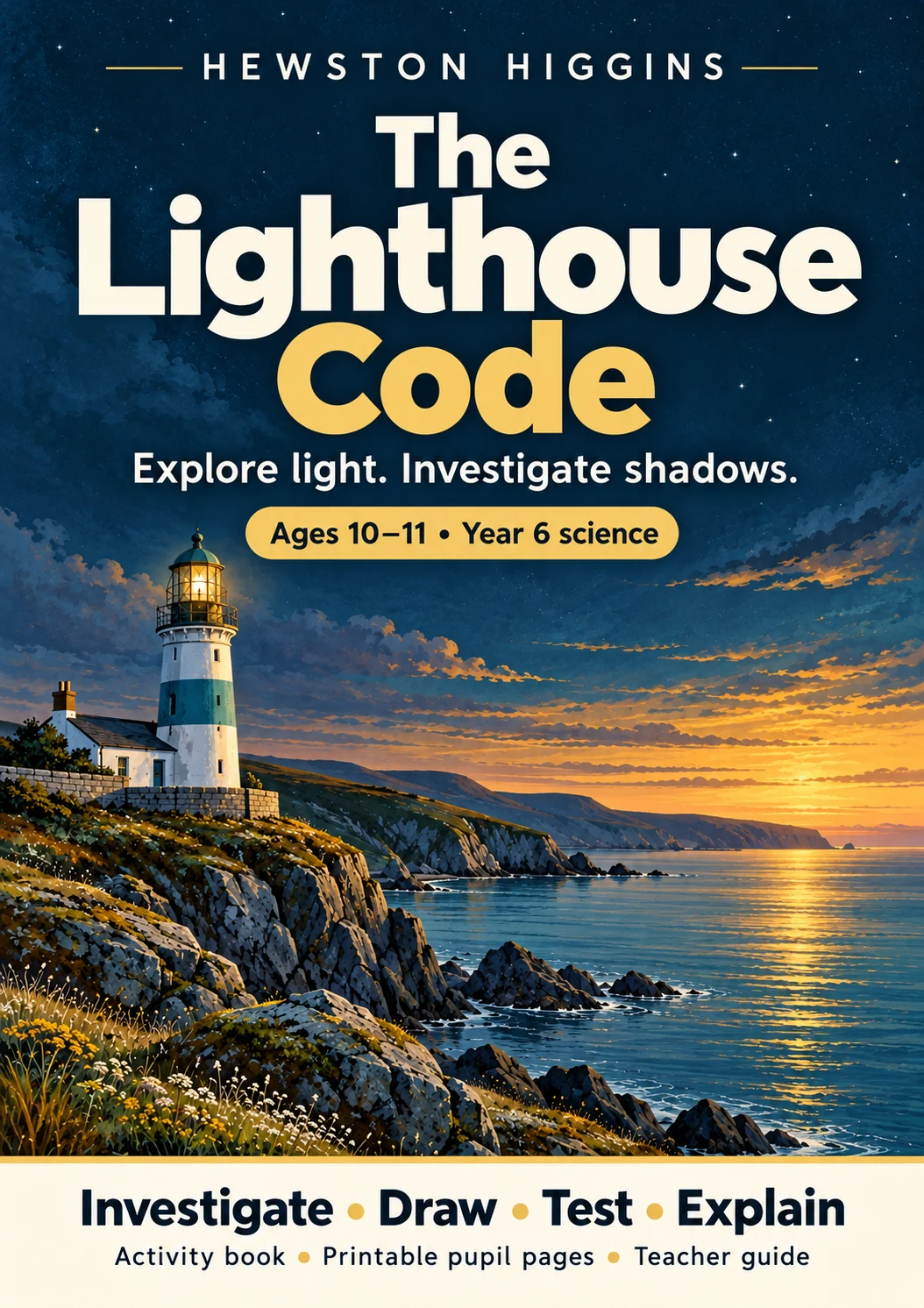
The Lighthouse Code front cover
Front cover
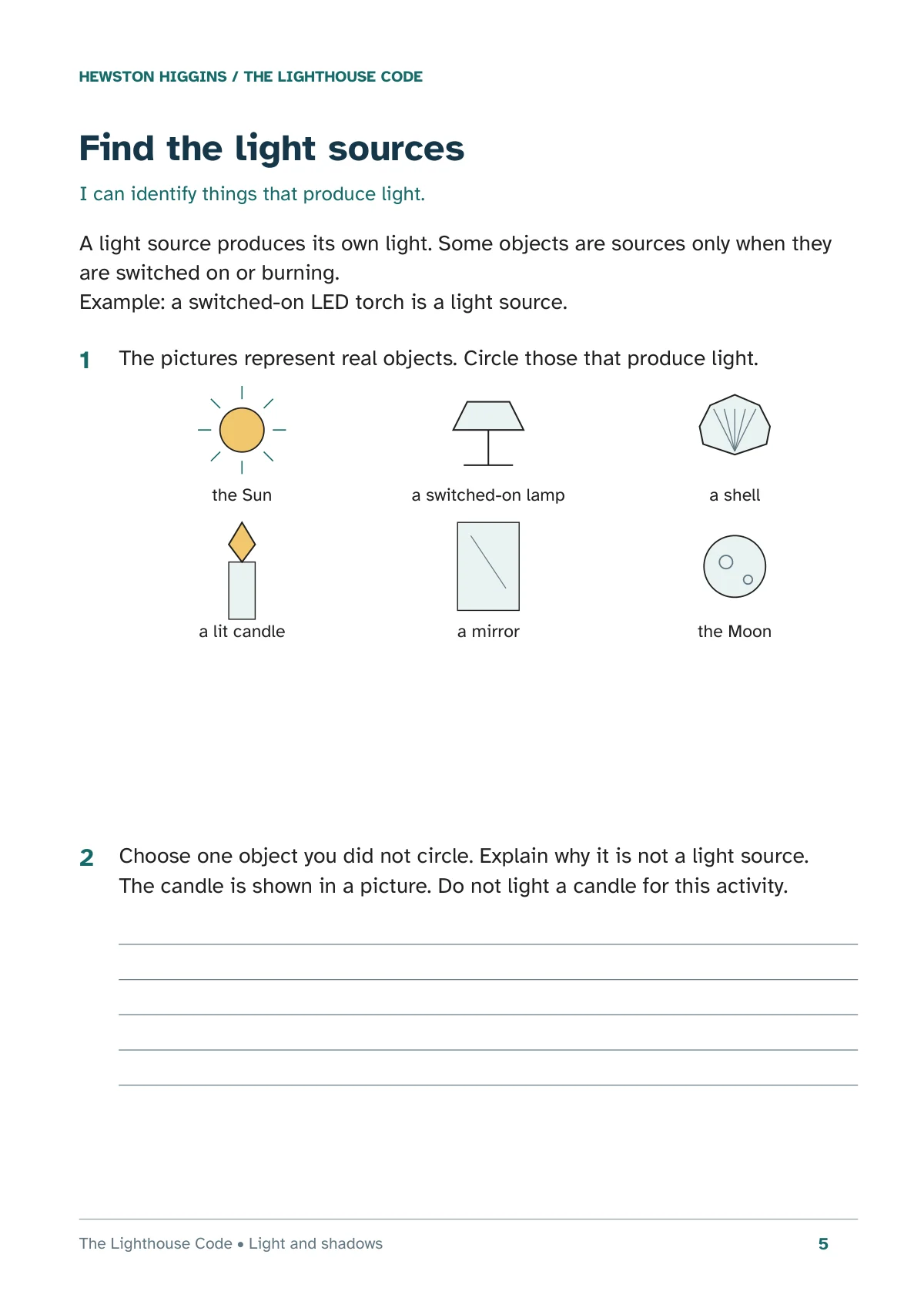
The Lighthouse Code sample page 1

Published four-page pupil sample — PDF page 1 of 4

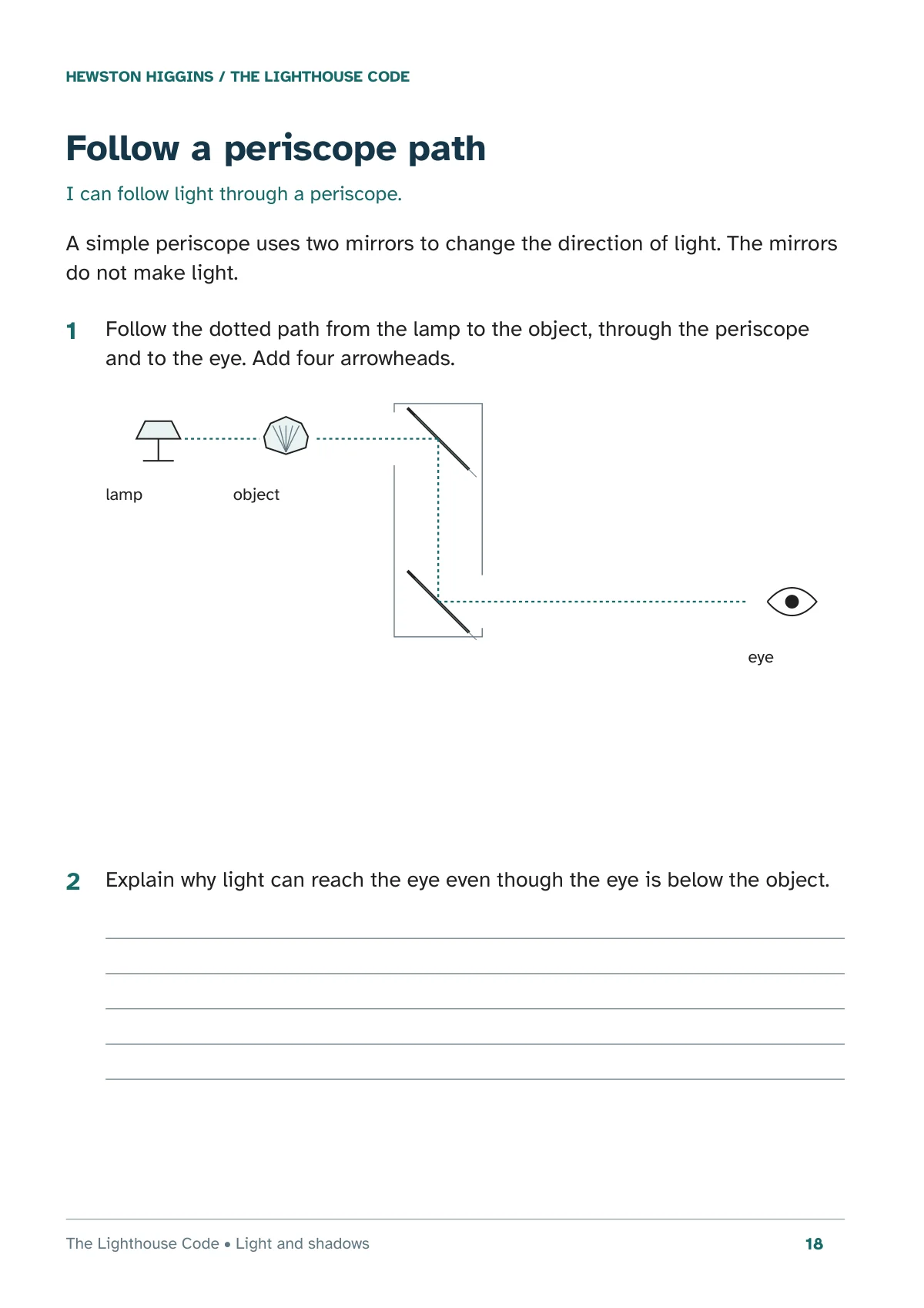
The Lighthouse Code sample page 2

Published four-page pupil sample — PDF page 2 of 4

About the book

A Year 6 science activity book for England, usually ages 10–11. Eighty A4 interior pages explore light sources, seeing, straight paths, mirrors, materials and shadows through predictions, diagrams, comparisons and investigations. The complete digital book has 82 pages including covers.

The Lighthouse Code activity book front cover

The complete book

A4 portrait. 82 PDF pages including covers, with 80 numbered interior pages. The sequence includes introductory pages, activities, practical investigations, additional challenges, assessment, reflection and a glossary.

Complete activity book PDF: member download. An A4 paperback is available separately. The complete book and matching printer-friendly pupil pages remain included with eligible membership.

See this book’s shop collection

Printer-friendly pupil edition

80 A4 pages with matching numbering and pupil wording. Low-ink black-and-white layouts keep instructions, diagrams, tables and response spaces clear.

Print only the pages you need within your licence. Pupils can draw light paths, label diagrams, record observations and write explanations as the group works through the main book.

Teacher guide

25 pages covering six teaching units, equipment, curriculum links, practical preparation, adaptations, answers and assessment guidance.

Choose a complete sequence or revisit a particular concept. Additional activities provide opportunities to consolidate learning and deepen explanations.

The Lighthouse Code: investigate, draw, test and explain; 80 pages of light and shadow activities

What pupils will explore

Light sources and seeing

Distinguish objects that emit light from objects that reflect it. Trace light from a source to an object and into an eye, and explain why a dark room needs a light source.

Straight paths and barriers

Draw clear light paths with directional arrows. Predict which objects can be seen when a barrier blocks a direct route and use evidence to explain a choice.

Mirrors and periscopes

Investigate reflected light, complete mirror routes and follow a two-mirror periscope path. Explain how a change in direction helps an observer see an object.

Materials and shadows

Compare transparent, translucent and opaque materials. Connect the formation and shape of a shadow to an object blocking a path of light.

Investigations and evidence

Make predictions, decide what to change and what to keep the same, measure shadow size, record observations, use supplied example data and explain results.

Apply, assess and reflect

Work through the additional challenges, use scientific vocabulary, complete three short assessment sections totalling 16 marks and reflect on what has become clearer.

Linked to the Year 6 science curriculum in England

The core topic is light. Tasks develop explanations of straight light paths, how light reaches the eye and how an opaque object creates a shadow. Mirror and periscope work applies these ideas. Earlier learning about materials and shadow size is revisited where it supports understanding.

Practical tasks also connect with upper Key Stage 2 scientific enquiry: pupils plan comparisons, consider variables, measure, record results and explain what their evidence supports. The teacher guide distinguishes the core curriculum links from supporting and extension activities.

Read the Department for Education’s science programme of study. This is an independently published resource; curriculum links do not imply government approval.

The Lighthouse Code: activity book, printable pupil pages and teacher guide

Use it on screen, on paper and through practical work

  1. Prepare: read the relevant teacher notes, choose the pupil pages and organise the equipment.
  2. Explore together: display the relevant book page within the rights granted by your licence, introduce vocabulary and invite predictions.
  3. Investigate: demonstrate safely or let pupils work in supervised pairs or small groups.
  4. Record: use the matching printer-friendly page for diagrams, tables, observations and explanations.
  5. Review: compare explanations with the guide, discuss evidence and choose consolidation or extension tasks.

Support participation without losing the science

Offer an oral explanation before writing, a word bank, a scribe, partner discussion or a practical demonstration. Reduce the number of questions while keeping the learning goal. Choose support according to the learner’s needs rather than age alone.

The book uses Atkinson Hyperlegible type, spacious A4 layouts, numbered tasks and clear diagram labels. These are design features, not a guarantee of accessibility for every learner. The resource has not been classroom trialled.

Equipment and safe preparation

Equipment is not included. Typical tasks use torches, child-safe mirrors, rulers, opaque card, white paper and everyday material samples. The guide gives activity-specific preparation. Adults should supervise practical work, use safe mirrors and avoid lasers, direct sunlight and bright light directed into eyes.

Full pupil-page contents

Numbers below refer to the printed interior numbering. The colour reading PDF also includes both covers. The pupil edition has the same 80 interior pages.

Open the complete 80-page contents list
PageTopic or activity
1This book belongs to you The Lighthouse Code
2Your investigation starts here
3What do you think already
4Your science toolkit
5Find the light sources
6Bright does not always mean source
7Light reaches an eye
8How can you see the shell?
9Repair the explanation
10The dark cupboard question?
11Draw a useful light ray
12The three hole challenge
13What blocks the route?
14Can light get around the partition?
15A mirror changes the direction
16Which mirror position works?
17Dull surfaces reflect too
18Follow a periscope path
19Explain the museum display
20Which materials let light through?
21Where will the shadow be?
22Match the outline
23Does a shadow copy the colours?
24Make a larger shadow
25Use rays to explain size
26Read the shadow evidence
27Plan a fair comparison
28Check the claims
29Turn the card
30Two lights two shadows
31Choose precise words
32Which explanation fits?
33Design a lighthouse display
34Crack the lighthouse code
35Investigation one plan the holes
36Investigation one record and explain
37Investigation two aim the reflection
38Investigation two review the evidence
39Investigation three plan shadow size
40Investigation three record and conclude
41Investigation four design a shadow sign
42Explain your shadow sign
43From an example to your explanation
44A different route to an eye
45Sources in changing situations
46What evidence would change your idea?
47Plan around a barrier
48Compare the two proposed paths
49The missing mirror
50Design notes for a periscope
51Plan a material comparison
52Record what the materials do
53Move the source think again
54One object different outlines
55Can a shadow identify the object?
56Do details survive in a shadow?
57One change at a time
58How consistent are the measurements?
59The unexpected result
60Plot the example evidence
61Make a bounded prediction
62Explain with boundary lines
63Make the apparatus more reliable
64Plan a mirror investigation
65Record the mirror investigation
66Why did the target go dim?
67Choose a display solution
68Build a full explanation
69What can the evidence support?
70Design a clear shadow message
71Review a model fairly
72A new setting the same science
73Explain it without the word bank
74Your final lighthouse design
75Retrieve before you review
76Show what you know seeing
77Show what you know shadows
78Show what you know reflection
79Look back and choose a next step
80Words for your investigations

About this book and its learning purpose

A Year 6 science activity book for England, usually ages 10–11. Eighty A4 interior pages explore light sources, seeing, straight paths, mirrors, materials and shadows through predictions, diagrams, comparisons and investigations. The complete digital book has 82 pages including covers.

Learning opportunities

  • Explain a light path to an eye
  • Use a diagram to explain a shadow
  • Plan a fair comparison and describe the evidence

A practical way to use it

Choose a light-path diagram or a shadow evidence task. Invite a prediction, model an explanation and compare it with the observations using the separate teacher guide.

SEND support and different ways to take part

Offer a word bank, practical demonstration, oral explanation or a scribe. Select fewer tasks while retaining the science goal. Adult supervision and activity-specific safe preparation are needed for practical work.

Read the detailed teaching plan for The Lighthouse Code — preparation, three flexible sessions, accessible activity choices, learning observations and follow-up.

Teachers can share the book on screen where the edition and licence permit, and use matching printer-friendly activity pages where available.

Frequently asked questions

What age is this book designed for?

The main curriculum level is Year 6 in England, usually ages 10–11. Educators may select activities for older learners consolidating these ideas. It is not a complete science course for ages 10–16.

What is included in the members’ library?

Eligible members can access the complete 82-page reading PDF, the matching 80-page printer-friendly pupil edition, the separate 25-page teacher guide and the two-page A4/A3 poster PDF. Access and reproduction follow the membership plan, licence and allowances.

How do I download the complete book?

The complete activity book PDF is included with eligible membership. It includes both covers and 80 interior pages. Eligible members can also download the teacher guide and A4/A3 poster.

Does the teacher guide include answers?

Yes. The 25-page guide includes six teaching units, equipment and preparation guidance, curriculum links, adaptation suggestions, assessment guidance and answers for the pupil pages. Practical measurements will vary; supplied example data are identified.

How many posters are included?

One promotional classroom poster design, supplied on two PDF pages: A4 and A3. The three website banners are promotional artwork and are not products.

Can the main book be displayed while pupils use the worksheets?

Within the rights granted by your membership, an educator can display the relevant reading page and give pupils the matching printer-friendly page. Both editions retain the same pupil text and numbering.

Is equipment included?

No. The guide lists equipment such as torches, child-safe mirrors, opaque card, paper, rulers and everyday material samples. Adults should prepare and supervise the practical tasks. Do not use lasers or look at the sun or directly into bright lights.

Can it support learners with SEND?

The layouts use clear type, generous writing space and short numbered instructions. An educator can offer oral answers, scribing, partner discussion, practical demonstration and selected pages according to individual needs. The resource has not been classroom trialled and does not claim a therapeutic outcome.

What does the public download licence cover?

Download the pupil book, teacher guide and poster through the member library. Check your membership licence for whole-school and multi-site use.

Book resources and member downloads

Already a member? Find this title in the library

Order the paperback

A4 paperback with 80 interior pages. Printed to order. UK delivery is confirmed at checkout.

Choose your resources

Eligible members can find the activity book, teacher guide and poster in the member library. Your membership licence covers where you can use them.

Complete activity book PDF · Member download

Download the complete 82-page A4 PDF, including both covers and 80 interior pages of activities, investigations, assessment, reflection and glossary. The paperback and member PDF have the same reading and activity content. Teacher guide and poster are sold separately.

Download through your membership

Eligible members already have access to the complete book and matching printer-friendly pupil edition under their membership. The teacher guide and poster are also listed separately in the members’ library.

Find member resources

Explore membership options

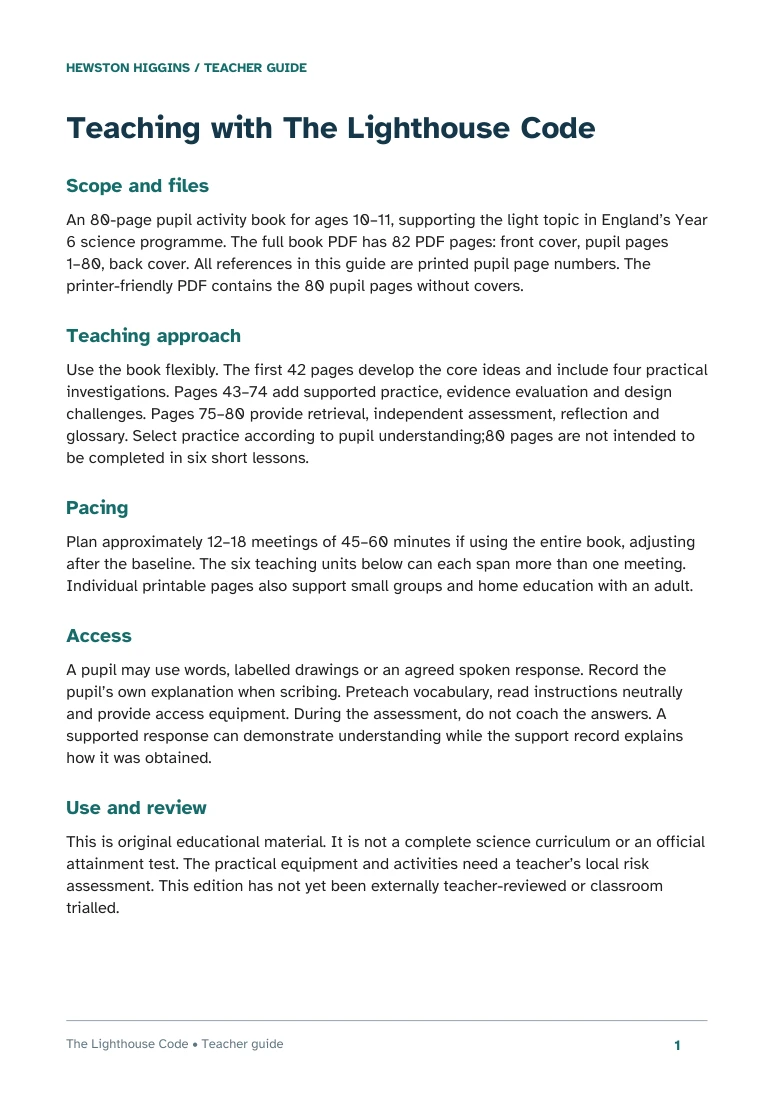
First page of The Lighthouse Code 25-page teacher guide
Teacher guide · 25-page PDF

Teacher guide

A separate 25-page PDF with six teaching units, planning, equipment, answers and assessment guidance. The pupil book has its own listing in the member library.

Teacher guide in the member library
The Lighthouse Code classroom promotional poster

A4 and A3 poster

One matching promotional classroom design, supplied as a two-page PDF: one A4 page and one A3 page. Enhanced from lower-resolution generated artwork for these print sizes. It introduces the book and its investigation theme.

Poster download in the member library

The three banners shown on this page are promotional website artwork and are not sold separately. The Lighthouse Code is available as an A4 paperback and an eligible member download.

Find this book’s member resources

Every active membership includes all published member resources. Choose a file below and sign in to download it within your plan’s allowances.

Posters / displays (1 listing)
Reading edition (1 listing)
Pupil companion (1 listing)
Teaching guidance (1 listing)

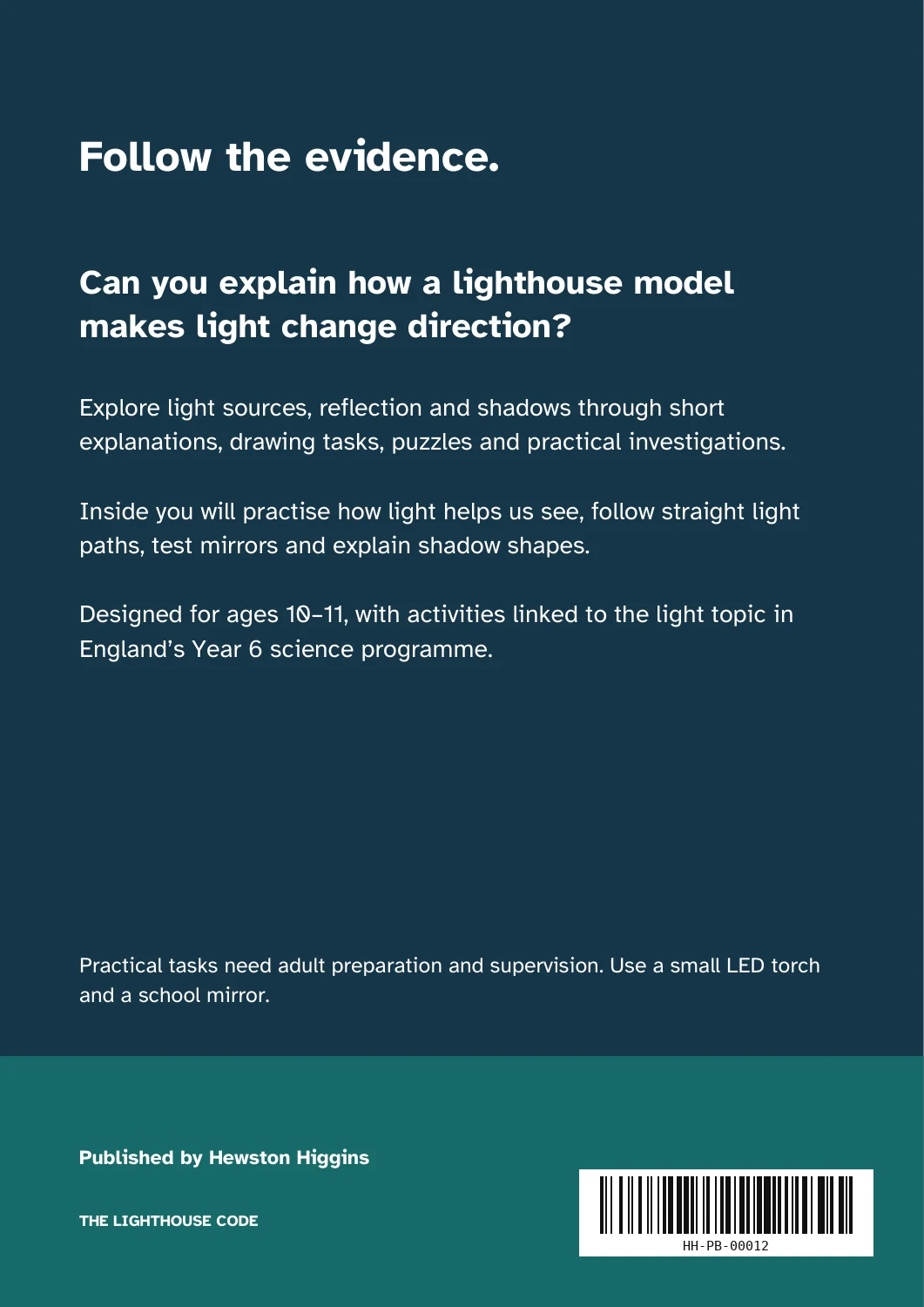
Back cover

Back cover of The Lighthouse Code

Classroom lesson

The Lighthouse Code

The Lighthouse Code sample page 1

The Lighthouse Code · Reading activity

Look together
Draw the path of light from a torch to a wall. What could change its direction?

Have a go
Add a mirror to the diagram and predict the new light path. Use arrows to explain your prediction.

Public lesson link

Listen to the book introduction

A lighthouse gives light a job to do. I liked that as a way into a science topic that can feel abstract. Drawing the route the light takes in one scene lets children explain what they think happens and see where they still have a question.

Choose a print format

The reading activity above is free to print in black and white on A4 or A3.

See membership options
Make a Now and Next board