Describe interactions
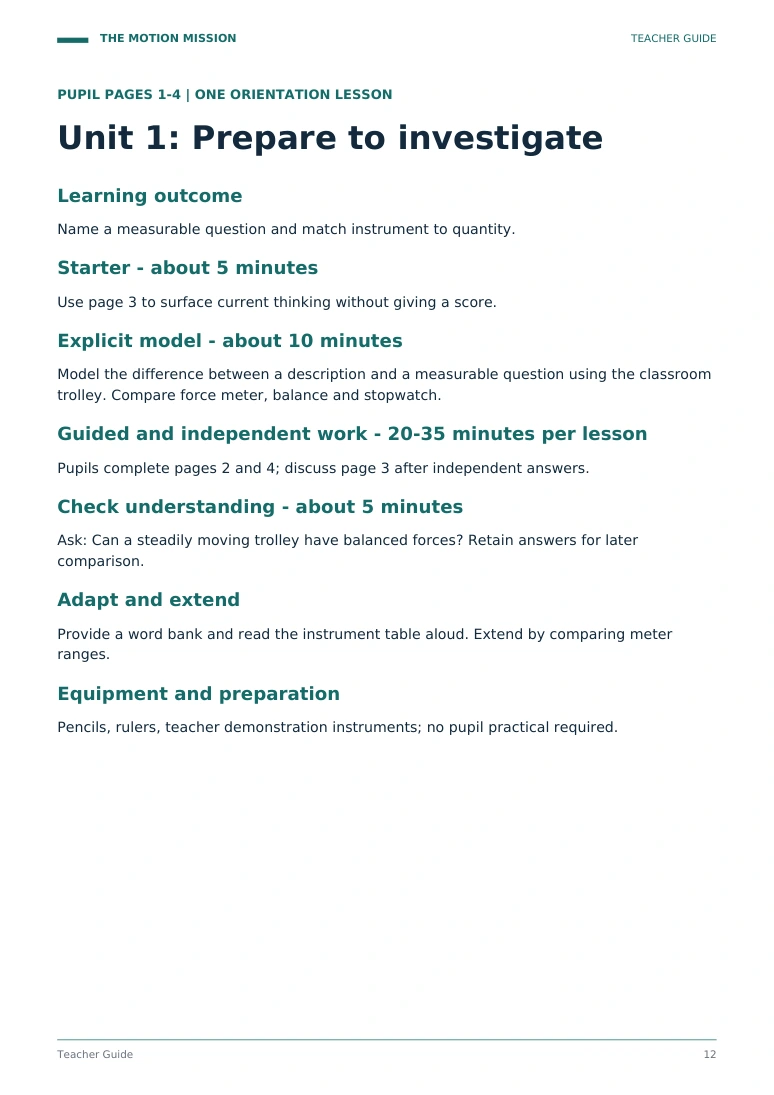
Name the objects exerting and receiving a force. Distinguish contact forces from gravity and magnetic forces, read a force-meter scale and keep newtons separate from kilograms.


Try the free activities for this book
Free classroom lesson and print formats · Listen
Movement is a good place to start with forces because pupils already have examples in their heads. I built the book around things they can picture moving. Sketching how a journey changes speed gives them something they can point to as they explain the physics.
Printed to order. Need it by a particular date? Ask us about dispatch before ordering.
An introductory Year 7 science activity book for England KS3, usually ages 11–12. Eighty interior pages move from force interactions and resultants to friction, average speed, cumulative distance-time graphs and a supervised trolley investigation. Activities ask learners to draw, calculate, test and explain.

Name the objects exerting and receiving a force. Distinguish contact forces from gravity and magnetic forces, read a force-meter scale and keep newtons separate from kilograms.
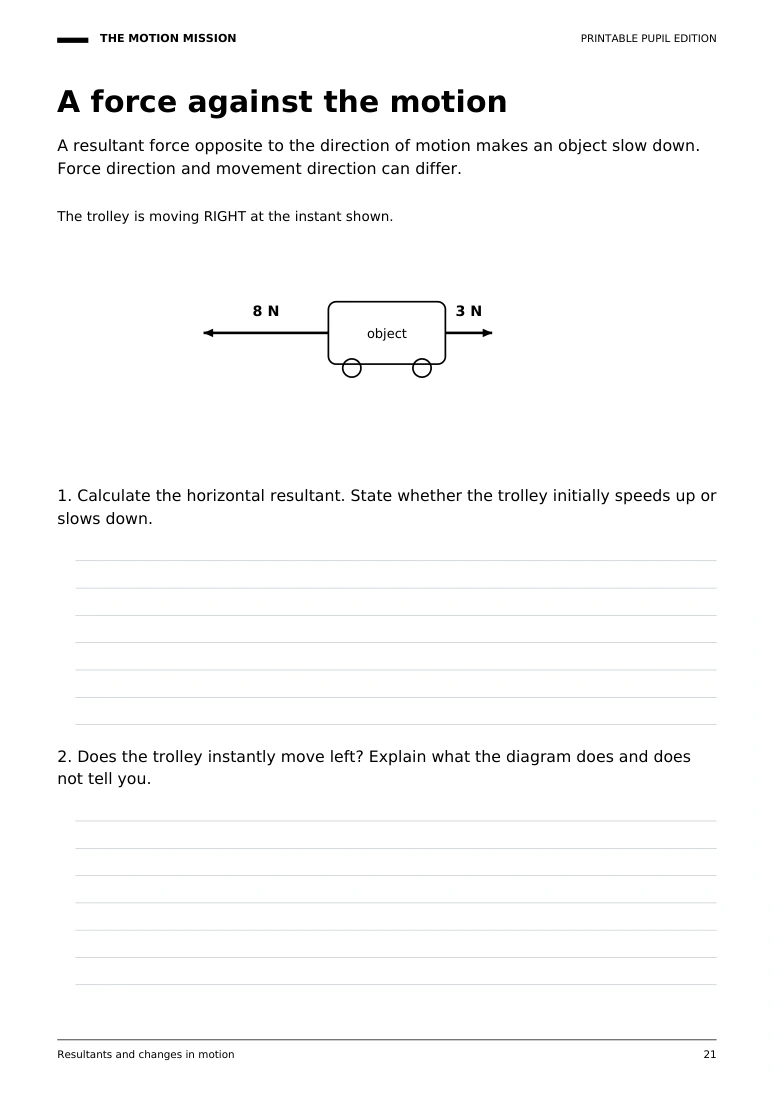
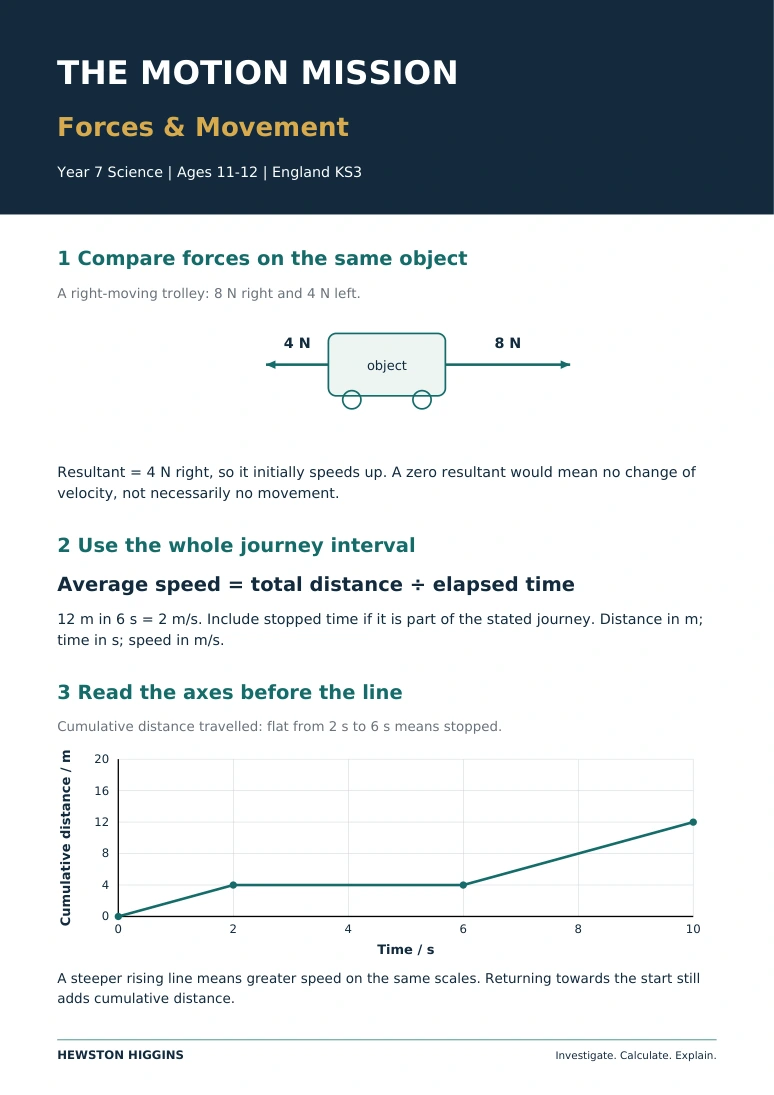
Draw force arrows, combine forces in one dimension and explain when a trolley speeds up, slows down or continues straight at steady speed. Moving does not automatically mean unbalanced forces.
Compare static and sliding friction, plan steady-pull comparisons, evaluate unusual readings and explore resistance in air and water.
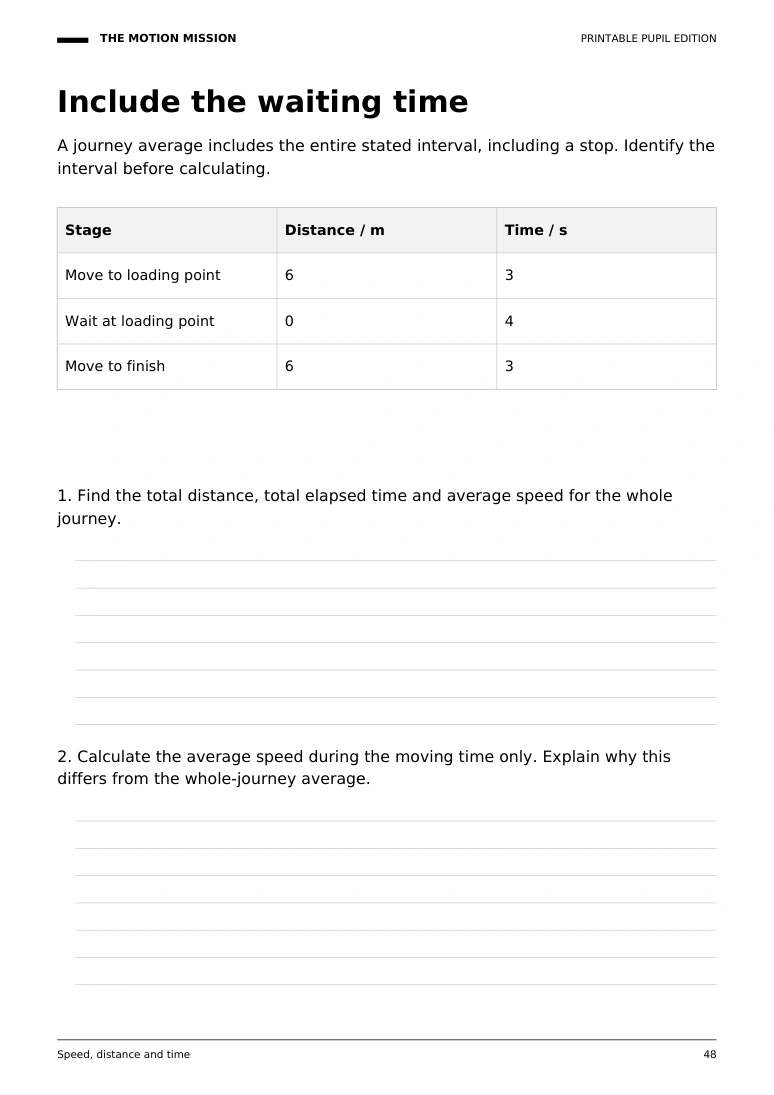
Use average speed, distance and time, convert centimetres and minutes, include stops in a whole-journey average and explain why simply averaging two speeds can be wrong.
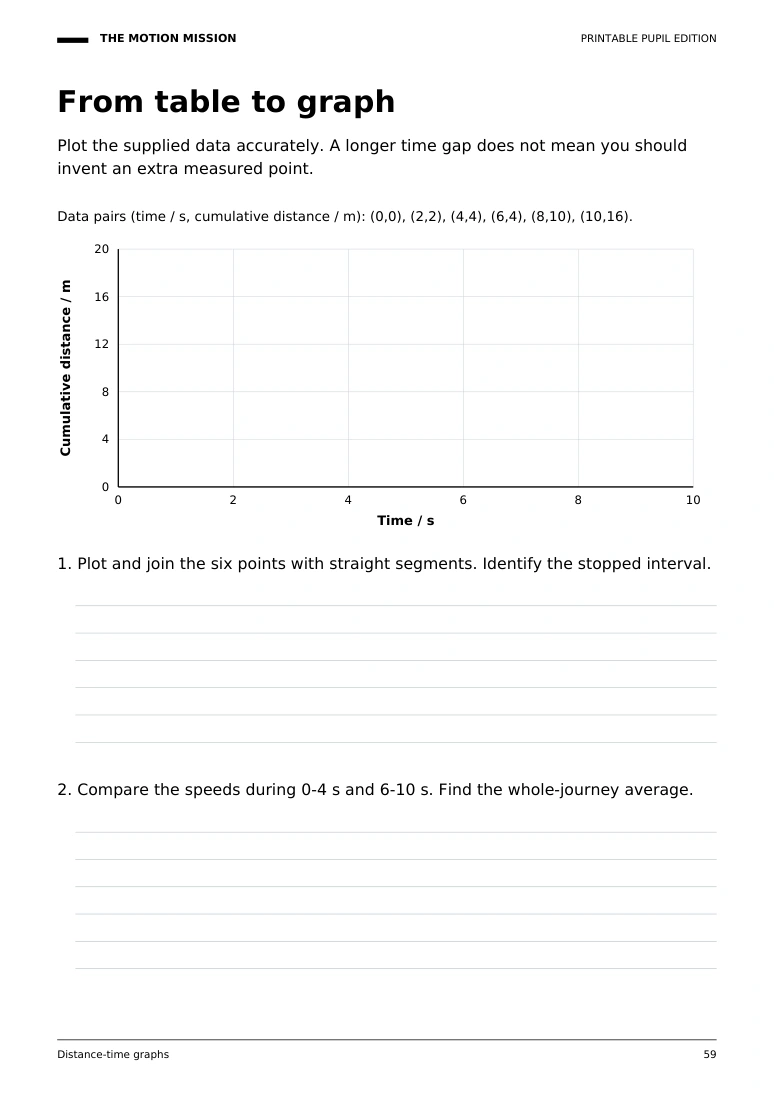
Plot cumulative distance against time, interpret slopes and stops, use changes over the correct interval and distinguish cumulative distance from position on a return journey.
Plan a supervised low-ramp investigation, identify variables and controls, analyse supplied or actual data, draw a height-speed graph and justify a bounded conclusion.
The core links are forces as interactions, forces measured in newtons, force arrows and one-dimensional resultants, balanced forces, qualitative changes in motion, friction and resistance, average speed and distance-time graphs. The investigation connects these ideas with planning, measurement, variables, data presentation, conclusions and evaluation.
Year 7 is the intended introductory level, usually ages 11–12. England specifies KS3 content across the key stage; schools choose their teaching sequence. Educators may select pages for older learners consolidating these concepts.
This is a selected-topic resource, not a complete KS3 science course or a complete ages 10–16 curriculum. Moments, pressure, Hooke’s law, numerical acceleration, a full energy treatment and relative motion need separate teaching.
Read the Department for Education science programme of study. Independently published; curriculum links do not imply official approval. The resource has not been classroom trialled.
Clear type, spacious A4 layouts, labelled diagrams and response areas support focused work. Educators can select fewer tasks, offer a word bank, read prompts aloud, allow oral or scribed explanations and allocate accessible practical roles. No font or layout guarantees access for every learner.
Equipment is not included. Typical tasks use a compact toy trolley, a low secured ramp, stable level track, a catcher, a tape measure, a stopwatch, suitable force meters, a block and surface samples. Adults must supervise practical work after a local risk assessment. Do not use ride-on trolleys or climb to increase release heights. Water comparisons are optional and teacher-led.
Five checkpoints support discussion. Four end assessments each have eight marks, giving 32 marks in total. The teacher guide supplies marking points and advice on follow-through, misconceptions and reteaching. These informal scores do not represent national grades.
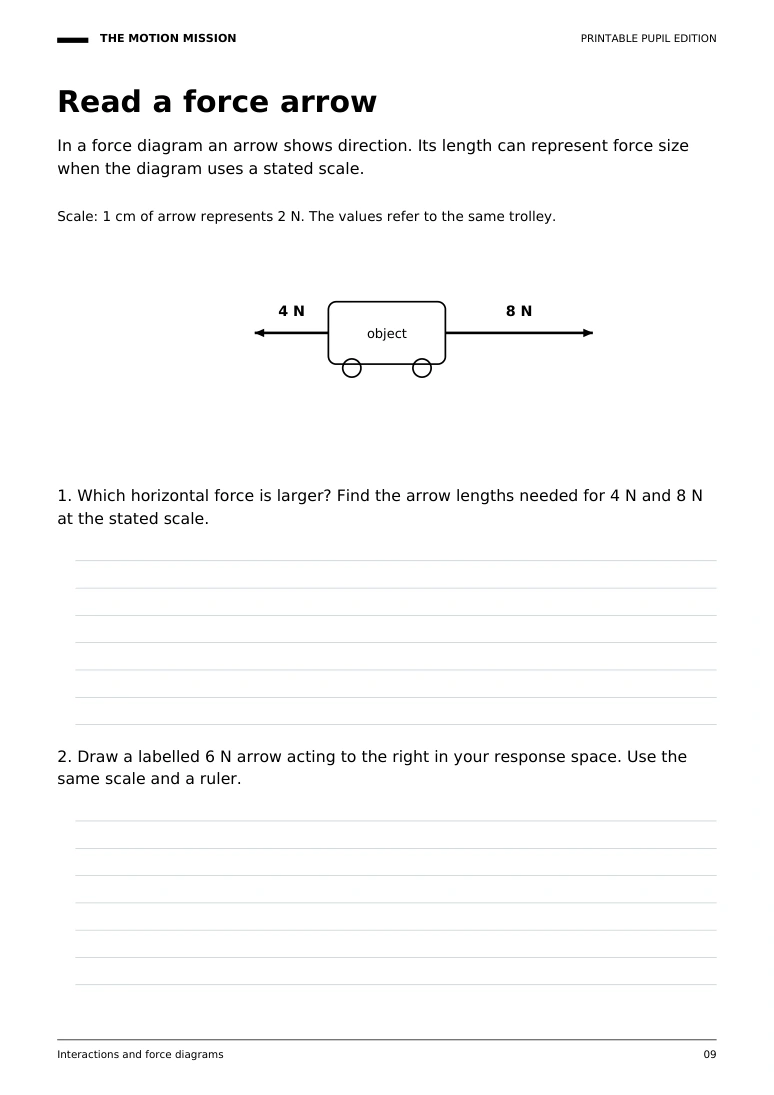
The complete PDF has 82 pages: two covers and 80 numbered interiors. Numbered pupil page n is PDF page n+1 in the complete book and page n in the low-ink edition. Print page 9 at 100% / actual size to retain its physical arrow scale. The cover is enhanced from lower-resolution generated artwork; instructional text, graphs and diagrams remain vector content.
| Page | Topic or activity |
|---|---|
| 1 | Your investigation record |
| 2 | Accept the motion mission |
| 3 | What do you think already? |
| 4 | Choose the right tool |
| 5 | A force needs an interaction |
| 6 | Contact or at a distance? |
| 7 | What can a force change? |
| 8 | Name the force on the object |
| 9 | Read a force arrow |
| 10 | Draw only forces on one object |
| 11 | Measuring a pull |
| 12 | Read between the marks |
| 13 | Mass is not weight |
| 14 | Use a weight model |
| 15 | Forces around a stationary book |
| 16 | First checkpoint: describe precisely |
| 17 | Combine forces in one line |
| 18 | Two pushes in the same direction |
| 19 | When forces balance |
| 20 | Zero resultant, two possibilities |
| 21 | A force against the motion |
| 22 | Which trolley changes speed? |
| 23 | The push ends |
| 24 | Turning is a change too |
| 25 | Balance in the vertical direction |
| 26 | Repair the motion report |
| 27 | Can we predict the final speed? |
| 28 | Second checkpoint: explain a journey |
| 29 | Friction between surfaces |
| 30 | Friction before sliding |
| 31 | A useful grip |
| 32 | Compare surfaces fairly |
| 33 | Use repeat measurements |
| 34 | Investigate an unusual reading |
| 35 | Air resistance needs air |
| 36 | Evaluate a paper-drop method |
| 37 | Forces on falling paper |
| 38 | Resistance in water |
| 39 | Design for the job |
| 40 | Third checkpoint: argue from evidence |
| 41 | Distance and time describe speed |
| 42 | Calculate three speeds |
| 43 | Find a distance from speed |
| 44 | Find a journey time |
| 45 | Make the units match |
| 46 | Check whether an answer fits |
| 47 | The same speed, different journeys |
| 48 | Include the waiting time |
| 49 | Do not just average the speeds |
| 50 | Plan a speed measurement |
| 51 | Calculate from repeated times |
| 52 | Fourth checkpoint: show your method |
| 53 | Read the graph axes |
| 54 | Plot a steady journey |
| 55 | A flat part means a stop |
| 56 | Compare the slopes |
| 57 | Use changes, not just coordinates |
| 58 | Describe the whole graph |
| 59 | From table to graph |
| 60 | A return journey still adds distance |
| 61 | Build a graph from a brief |
| 62 | How much can a graph tell us? |
| 63 | Check a graph before trusting it |
| 64 | Fifth checkpoint: read and calculate |
| 65 | Investigation: choose a question |
| 66 | Investigation: make a safe method |
| 67 | Investigation: collect your evidence |
| 68 | Investigation: analyse example data |
| 69 | Investigation: draw your evidence |
| 70 | Investigation: write a conclusion |
| 71 | Investigation: evaluate the method |
| 72 | Investigation: propose a next test |
| 73 | Apply: choose a delivery route |
| 74 | Apply: challenge the trolley advert |
| 75 | Assessment A: forces and motion |
| 76 | Assessment B: speed and units |
| 77 | Assessment C: graph evidence |
| 78 | Assessment D: plan and evaluate |
| 79 | Review your evidence of learning |
| 80 | Words to take forward |
An introductory Year 7 science activity book for England KS3, usually ages 11–12. Eighty interior pages move from force interactions and resultants to friction, average speed, cumulative distance-time graphs and a supervised trolley investigation. Activities ask learners to draw, calculate, test and explain.
Select a force-diagram or supplied-data task, model the first decision and ask learners to explain their method. Use the teacher guide for equipment, safe preparation and answers.
Offer word banks, read-aloud prompts, oral or scribed explanations and accessible practical roles. Older learners can use selected pages for consolidation; this is not a complete KS3 course.
Read the detailed teaching plan for The Motion Mission — preparation, three flexible sessions, accessible activity choices, learning observations and follow-up.
Teachers can share the book on screen where the edition and licence permit, and use matching printer-friendly activity pages where available.
The intended introduction is Year 7 in England, usually ages 11–12. Schools decide their KS3 teaching order. Older learners may use selected pages for consolidation; this is not one complete course for ages 10–16.
The complete activity book PDF only: 82 pages including both covers and 80 numbered interior pages. Eligible members can download the printable pupil pages, teacher and planning pack, and poster separately.
Eligible members can access all four resources: the complete book, matching 80-page low-ink pupil edition, teacher/planning ZIP and A4/A3 poster PDF. Use, access and download allowances follow the membership licence.
Yes. It contains the 60-page guide with eight teaching units and answers to every pupil task, plus the 42-page page/design plan with exact pupil wording and production details. It does not include the pupil editions or poster.
One original teaching-poster design, supplied in two sizes on two PDF pages: A4 and A3. The website banners are promotional artwork, not extra posters.
Yes. Supplied example data and paper-based alternatives support the investigation. These are labelled and must not be presented as a class’s own observations.
The A4 paperback is a physical book. The companion resources on this page are digital downloads.
Check your school or trust membership licence for who can access materials and where you can use them.
These are readable previews rendered from the reviewed PDFs. Open a page image to inspect it at full size, or download the four-page pupil sample. Nothing is cropped from the page.
Already a member? Find this title in the library
Use the digital files within the licence and download allowances for your membership.
82-page A4 PDF: illustrated front and back covers plus 80 numbered interior pages. Includes activities, practical planning, graphs, four assessments, reflection and a glossary. The member download contains the complete book.
Download through your membership80 low-ink A4 PDF pages with matching pupil wording, numerical data, diagrams and numbering. Use independently for the written tasks or alongside the main book on screen within your licence. No colour covers are included.
Open in the member libraryZIP containing the 60-page teacher guide and 42-page page/design plan. Eight teaching units, suggested lesson sequences, curriculum map, equipment, safe preparation, adaptations, complete answers and assessment marking guidance. Eligible members can also download the pupil editions and poster.
Open in the member libraryOne original vector teaching-poster design supplied on two PDF pages: A4 and A3. Reinforces force resultants, average speed and reading cumulative distance-time graphs. This is one design in two sizes, not a ten-poster collection.
Open in the member libraryOpen eligible member downloads
The three banners are promotional website artwork and are not retail products.
A4 paperback with 80 interior pages. Printed to order. UK delivery is confirmed at checkout.
Every active membership includes all published member resources. Choose a file below and sign in to download it within your plan’s allowances.
The Motion Mission
Look together
A trolley has a 6 N push right and 2 N resistance left. Which way is the resultant force?
Have a go
Draw force arrows to a scale of 1 cm for 2 N. Label the resultant and check it against your prediction.
Movement is a good place to start with forces because pupils already have examples in their heads. I built the book around things they can picture moving. Sketching how a journey changes speed gives them something they can point to as they explain the physics.
The reading activity above is free to print in black and white on A4 or A3.