Alban
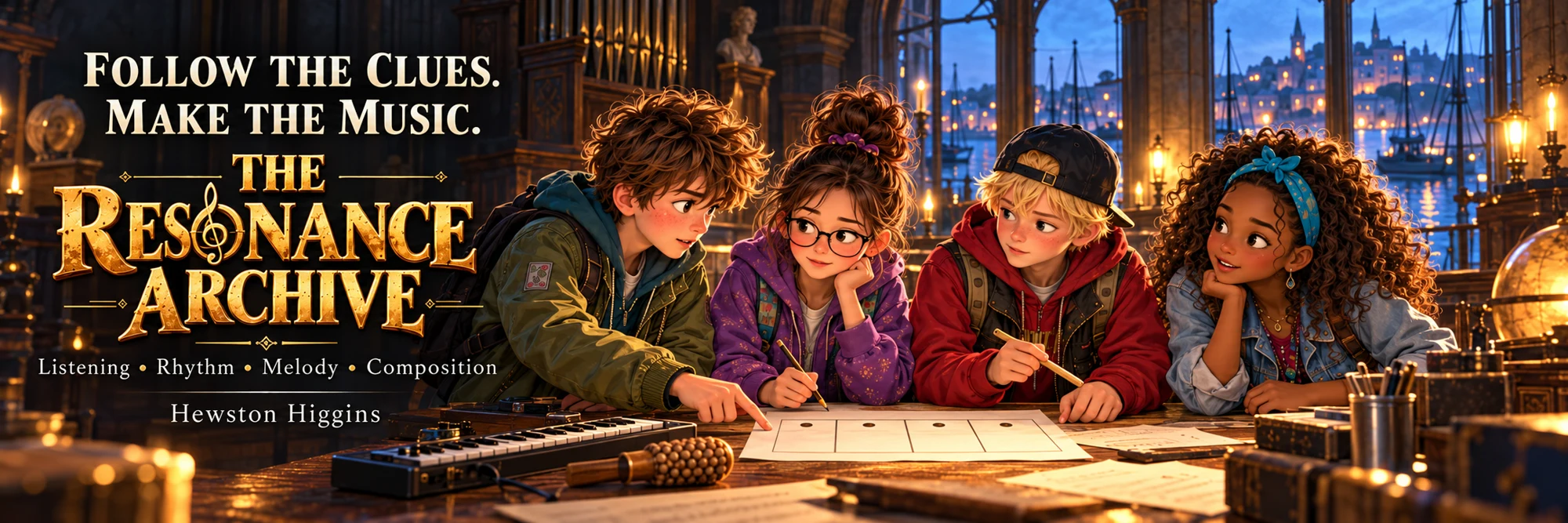
The attentive listener and recorder, alert to small details hidden beneath the obvious sounds.

Try the free activities for this book
Free classroom lesson and print formats · Listen
What if the detail you needed to solve a mystery was something you’d heard? That was my starting point for the festival score. Readers can listen, tap or describe a musical clue and compare what changes when they try it another way.
Printed to order. Need it by a particular date? Ask us about dispatch before ordering.
Complete 48-page reading edition — PDF page 3 of 48
Complete 48-page reading edition — PDF page 5 of 48
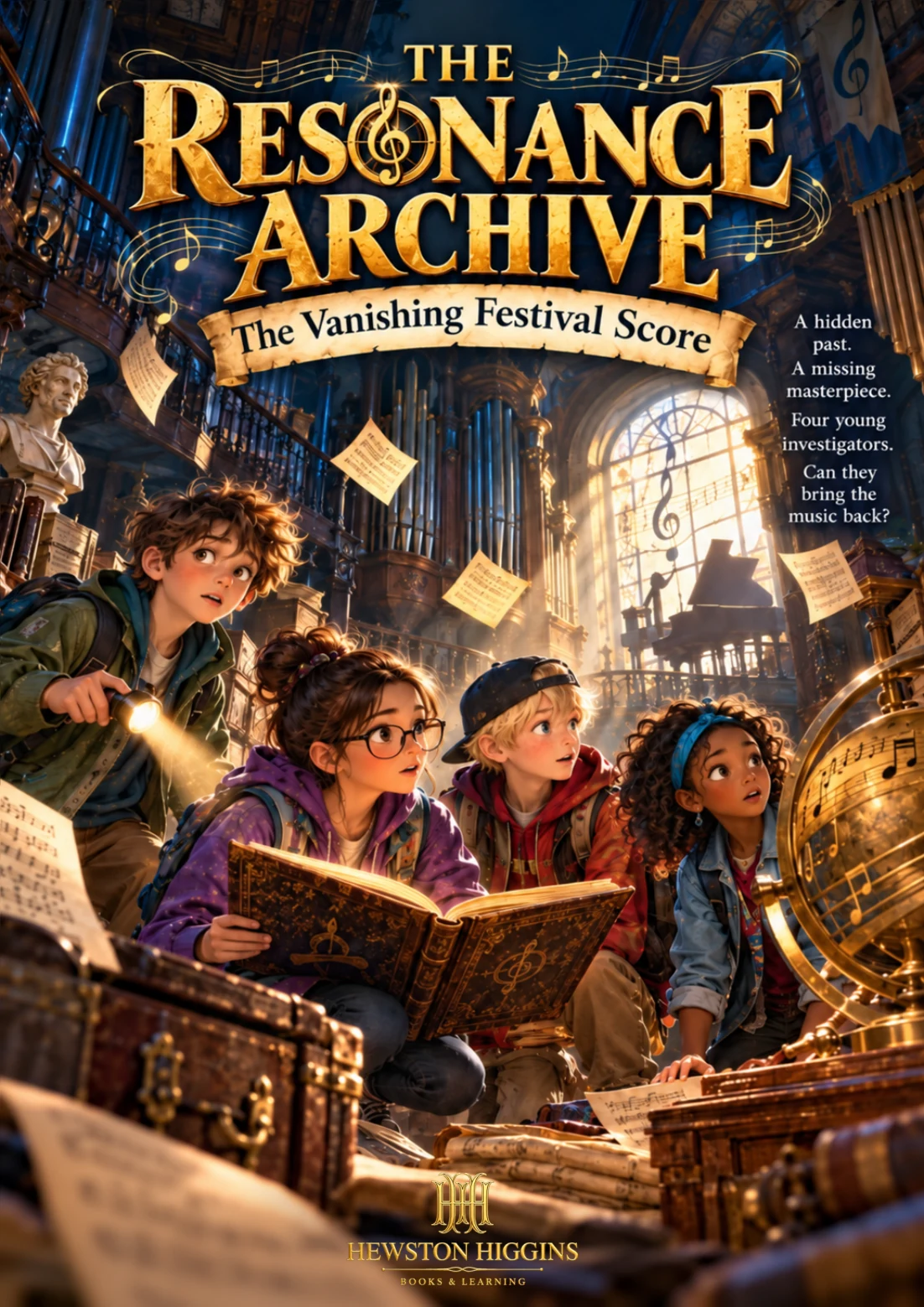
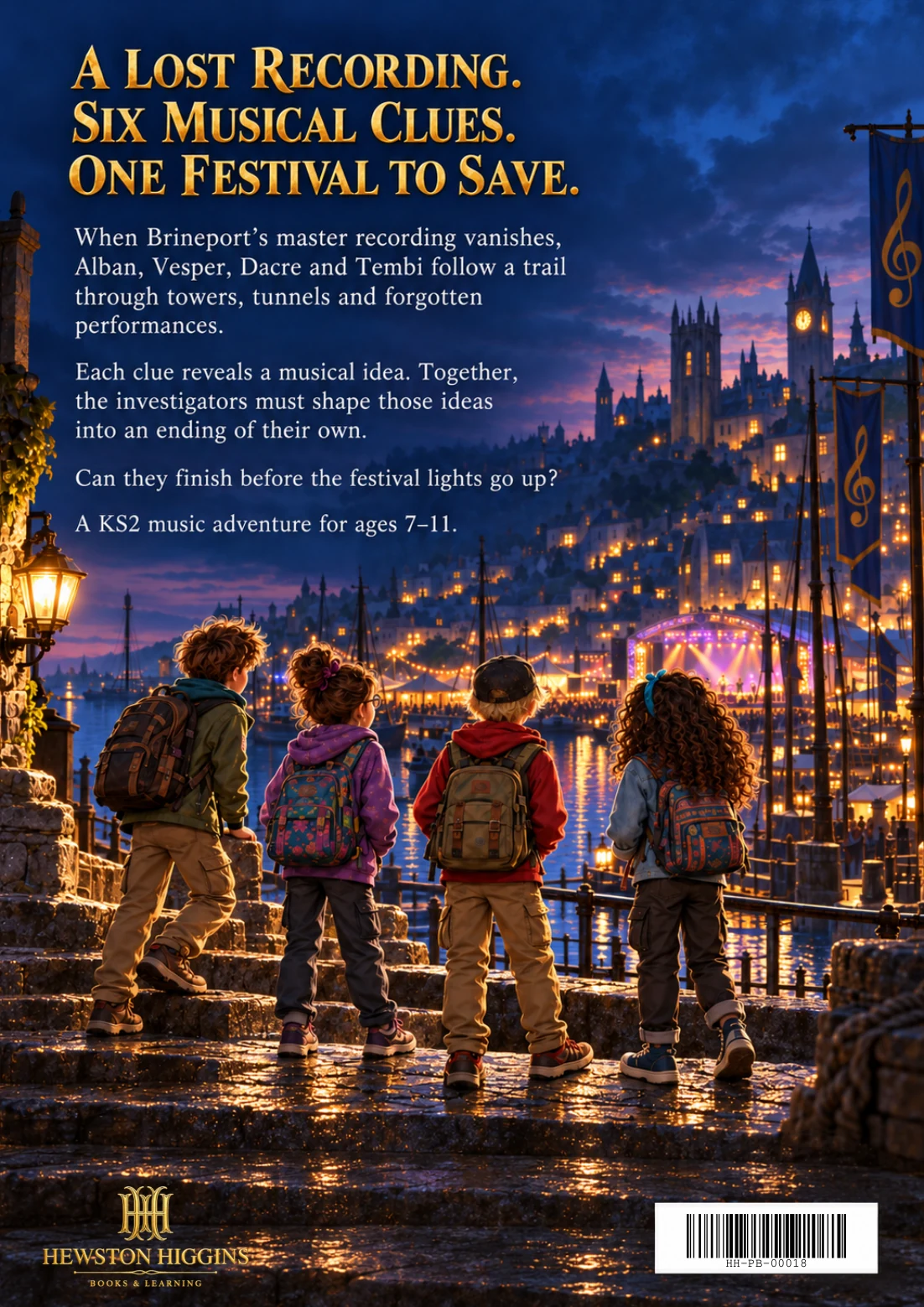
A cinematic 48-page KS2 music mystery for ages 7–11. Follow Alban, Vesper, Dacre and Tembi through six musical clues, with 13 teacher lessons, a 15-page printable activity pack and ten activity posters in A4/A3.
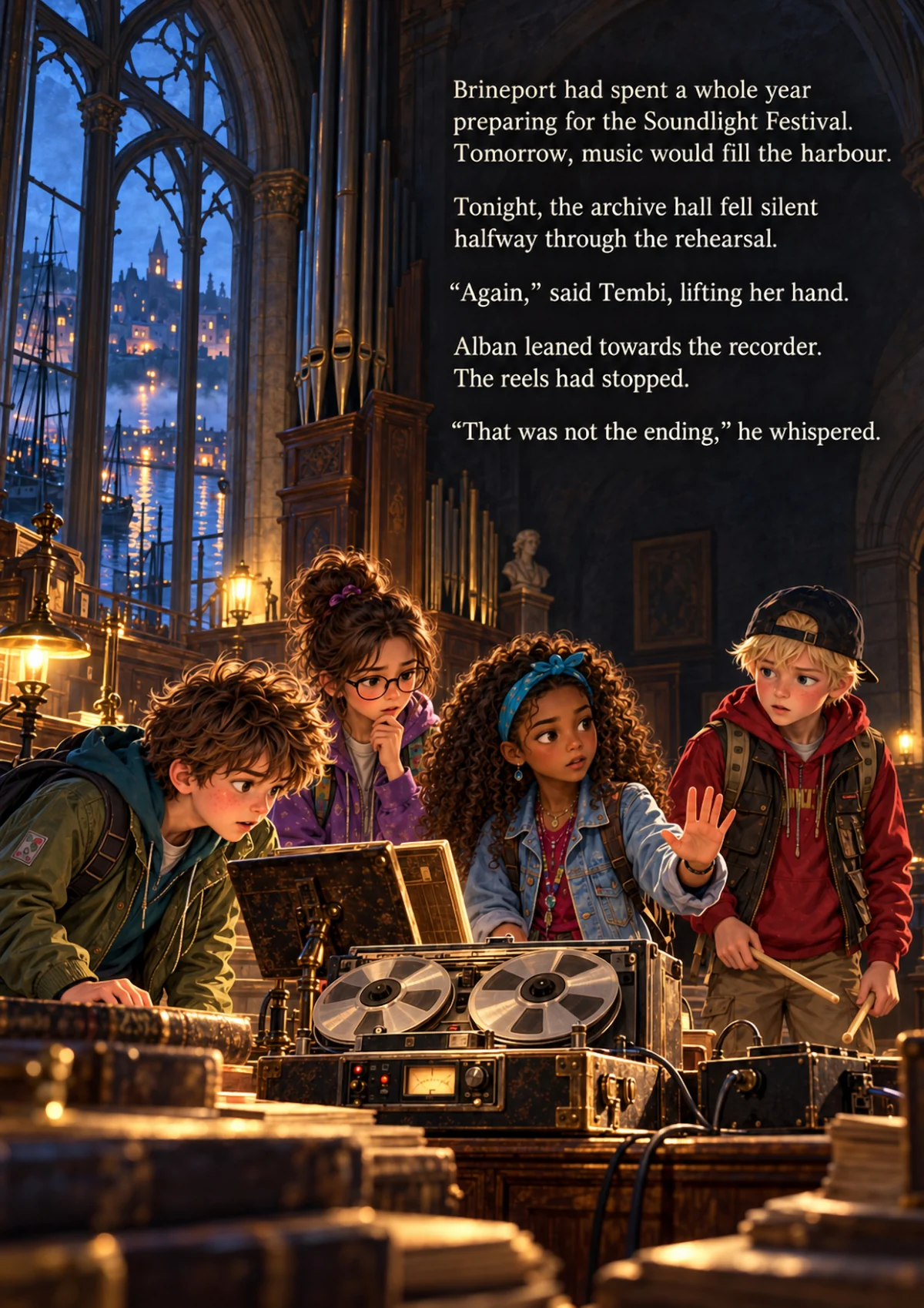
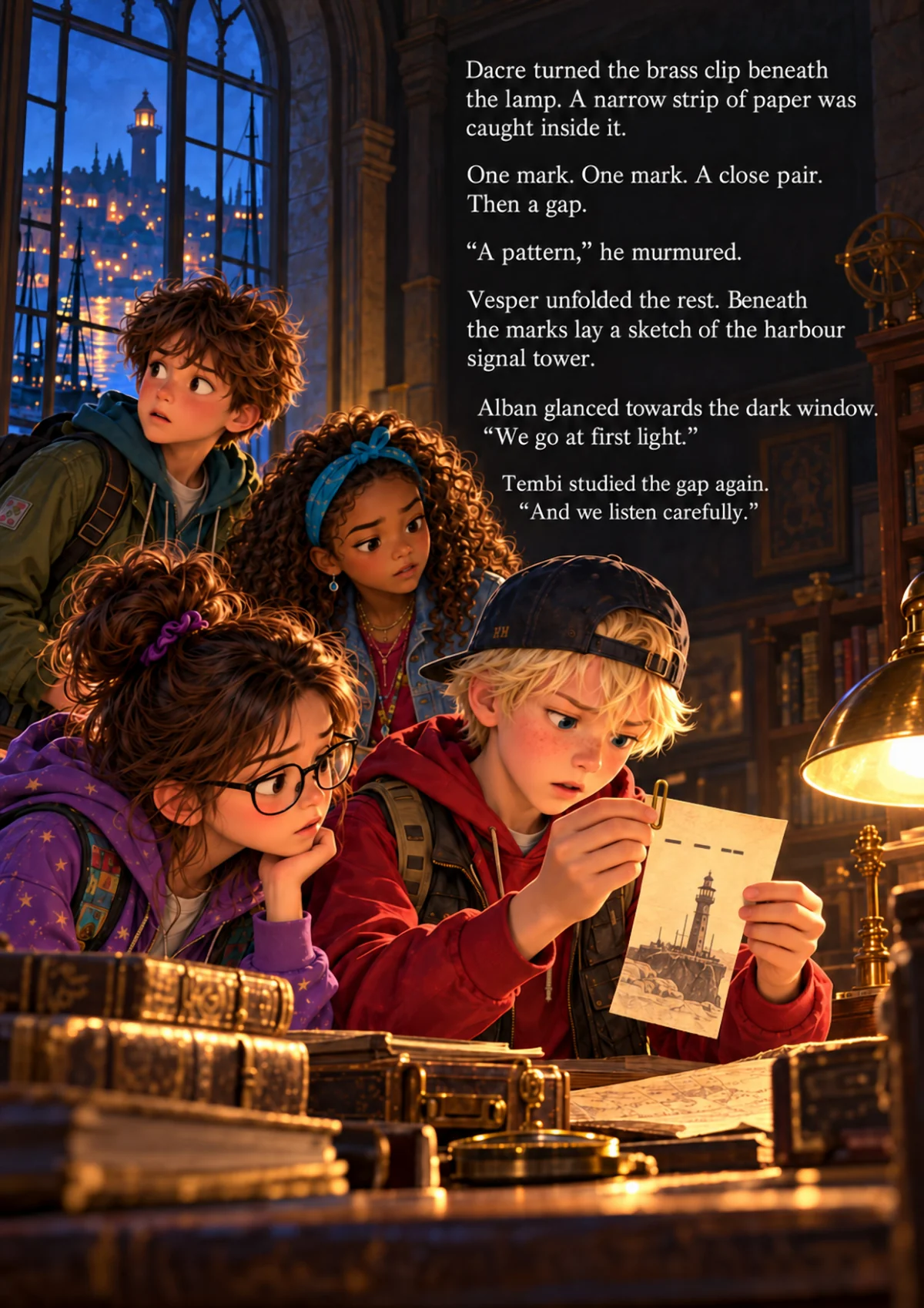
Brineport has spent a year preparing for the Soundlight Festival. On the night before the celebration, a rehearsal recording stops halfway through. The original master reel should hold the missing music—but its case is empty. In its place lies a small brass clip and a curious pattern: one mark, one mark, a close pair, then a gap.
Alban, Vesper, Dacre and Tembi set out at first light. Their trail leads from the harbour signal tower to the railway arch, through a glasshouse of ringing chimes and into an old cinema where silent pictures come alive through music. Each new clue reveals another part of the piece: a steady pulse, a changing rhythm, a rising melody, a repeating pattern, contrasting sound colours and layers that fit together.
With archive engineer Dr Sen’s help, the investigators discover that recovering a recording is only part of their challenge. To bring the festival music back, they must listen to one another, make decisions, rehearse and leave room for ideas of their own. Can they finish before the harbour lights go up?
Full-page cinematic illustrations carry the story and its wording together. Practical music invitations appear within the adventure, giving readers a chance to pause, explore a clue and become composers themselves.
The attentive listener and recorder, alert to small details hidden beneath the obvious sounds.
The keyboard player who tests melodies, notices patterns and helps musical ideas take shape.
The percussionist who discovers how pulse, rhythm and a carefully held silence can unlock a clue.
The composer and director who helps the group make choices, share cues and leave space for each contribution.
The story gives musical ideas a purpose: remembering a pattern, comparing two sounds, following a melody or shaping a performance. Use it for shared reading, small-group enquiry or a sequence of practical music lessons. Reading and discussion can also support vocabulary, explanation and evidence-based reasoning.
Designed for ages 7–11 across KS2. Teachers can simplify the choices or extend the notation and composition tasks to match pupils’ experience.
Playing an instrument is one way to contribute. Children can also choose a sound, point to a pattern, arrange objects, direct a partner, cue an entry, compose, record or review. Activities offer routes through AAC, visual plans and partner-assisted choices, with seated roles and comfortable sound levels.
Use these options around each pupil’s communication, sensory and physical needs. Standard staff notation is an available learning route; children can also represent ideas through marks, words, objects or digital sequencing. No child needs to sing, stand or perform publicly to take part.
Simple percussion and safe everyday sound sources support many tasks. For melody work, use a keyboard, tuned percussion or prepared audio. Classroom listening uses appropriately licensed recordings selected by the teacher; recordings, audio tracks and instruments are not included.

A cinematic 48-page KS2 music mystery for ages 7–11. Follow Alban, Vesper, Dacre and Tembi through six musical clues, with 13 teacher lessons, a 15-page printable activity pack and ten activity posters in A4/A3.
Choose a musical clue and record what can be heard or read. Compare rhythm, tempo or timbre through quiet demonstrations, descriptions or symbols.
Put the clue beside a simple rhythm or tempo symbol. Offer a muted recording, a visual beat strip or a quiet demonstration so pupils can compare it at a comfortable volume.
Read the detailed teaching plan for The Resonance Archive: The Vanishing Festival Score — preparation, three flexible sessions, accessible activity choices, learning observations and follow-up.
Teachers can share the book on screen where the edition and licence permit, and use matching printer-friendly activity pages where available.
The story and activities are designed for KS2, typically ages 7–11. Adults can read the story aloud and adapt the practical work to pupils’ musical experience.
Both. The 48-page reading edition combines a continuous fictional mystery with practical musical invitations. Separate teacher resources support thirteen lessons, and ten activity poster designs revisit selected investigations.
A ZIP containing the 29-page guide and 15-page printable activity PDF. The reading book and poster bundle are separate resources.
Yes. It includes all ten designs in two ten-page PDF collections, one for each paper size. These use the book’s approved activity artwork; they are not ten additional story pages.
No. Children can contribute through composing, choosing, directing, AAC, listening or reviewing, with a partner or adult performing selected sounds where needed.
No. The festival and recordings in the story are fictional. Teachers select appropriately licensed classroom recordings, credit performers and provide context.
Paperback available to order for £9.99. Printed using our interim printing arrangements; UK delivery is confirmed at checkout.
Already a member? Find this title in the library
The complete 48-page A4 reading PDF, including front and back covers, belongs in the eligible members’ library. Sign in and search for Resonance Archive to find the reading edition, teacher/activity bundle, separate teacher guide, printable activities and poster collections.
Downloads follow your active plan, membership licence, allowances and access rules. The complete book PDF is not sold as a standalone downloadable-book purchase.
Open the member libraryPaperback available to order for £9.99. Printed using our interim printing arrangements; UK delivery is confirmed at checkout.
Visit the Resonance Archive shop collection for the book’s edition options, posters and teacher resources.
Paperback available to order for £9.99. Printed using our interim printing arrangements; UK delivery is confirmed at checkout.
UK tracked delivery is £3.99 below £29.98. Free UK tracked delivery on paperback orders of £29.98 or more.
Separate classroom companion · Digital ZIP
Move from the mystery to purposeful classroom music with a 29-page comprehensive teacher guide and a separate 15-page printable activity PDF. The pack provides a coherent route through thirteen lessons, while letting teachers choose the pace and level of support.
Thirteen lessons with aims, vocabulary, equipment, worked models, teaching sequences, answer guidance, common misconceptions, access routes, entry points, extensions and assessment observations.
Planning and response sheets for rhythm, melody, ostinato, sound design, texture, scene scoring, listening, structure, rehearsal and an ensemble. Includes checked duration and treble-clef pitch references, reflection and an observation form.
The teacher/activity pack excludes the complete reading book and classroom poster collection. Eligible member access follows the membership licence and allowances.
Ten designs · Both paper sizes · Digital ZIP
Keep the musical investigations in view with ten full-colour activity designs taken from the approved book artwork. Each brings the illustration and its activity wording together: useful for a music area, a shared discussion or revisiting a task after the story.
The bundle contains two ten-page PDF collections: one A4 and one A3. Both sizes are included for eligible members. Choose the matching PDF and print at actual size. Eligible members can also select the A4 and A3 sets separately in the library.
The ten topics are Four-beat investigation; Make a four-beat answer; Melody map; Build an ostinato; Sound design lab; One layer, two, three; Score a silent scene; Design a musical journey; Rehearsal check; and Music toolkit.
Artwork has been enhanced from lower-resolution sources using the established free FSRCNN process and verified at at least 300 ppi at its intended A4 or A3 placement. This describes the enhanced output; it does not imply native high-resolution source detail.
Single-classroom / individual-practitioner retail licence. Member use follows the membership licence and allowances. Printed posters are not included.
Every active membership includes all published member resources. Choose a file below and sign in to download it within your plan’s allowances.
The Resonance Archive: The Vanishing Festival Score
Look together
Tap a four-beat pattern, then leave one beat silent. Which part became a clue?
Have a go
Write the pattern using your own symbols. Swap scores and see whether another musician can recreate it.
What if the detail you needed to solve a mystery was something you’d heard? That was my starting point for the festival score. Readers can listen, tap or describe a musical clue and compare what changes when they try it another way.
The reading activity above is free to print in black and white on A4 or A3.