
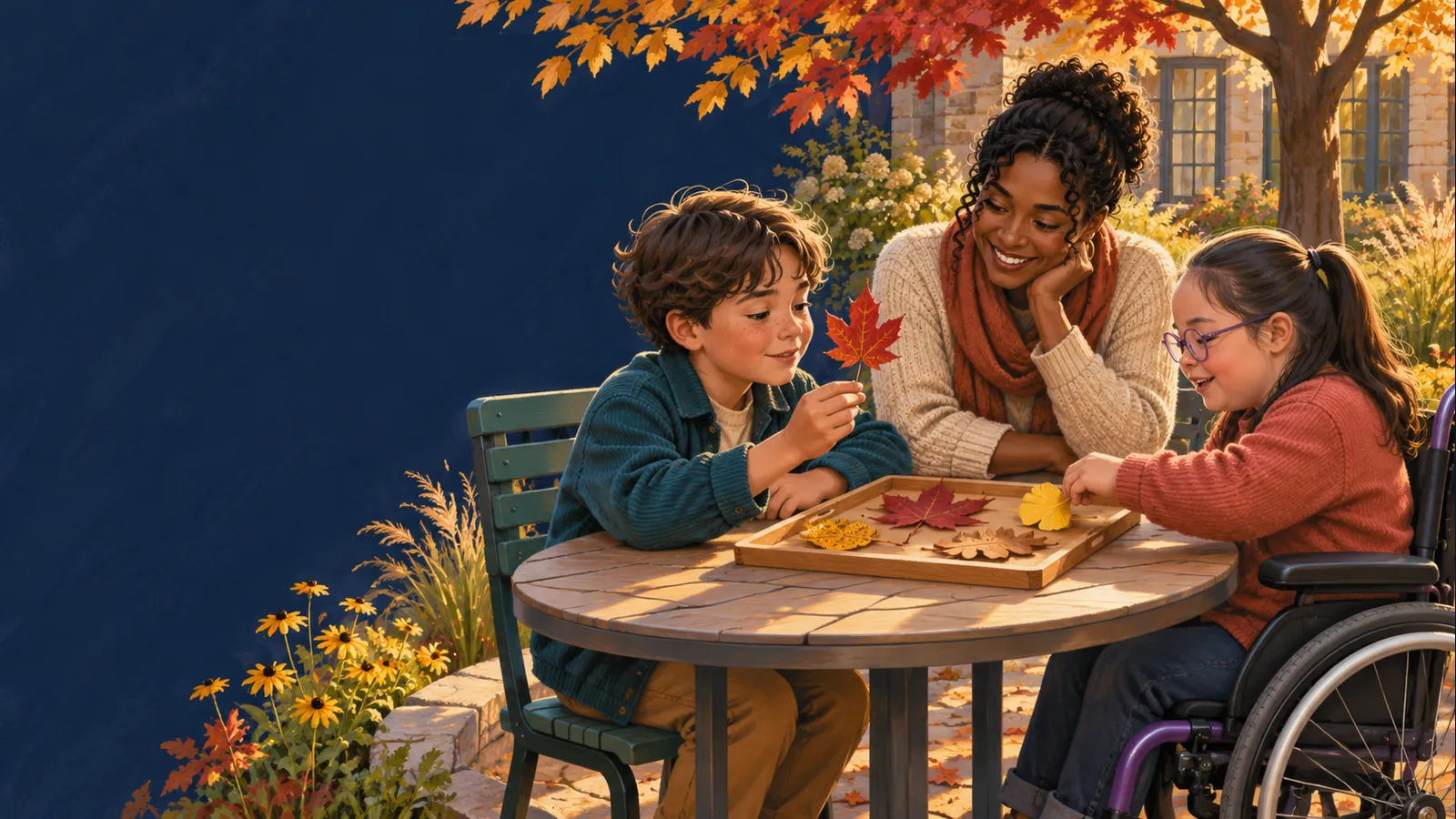
A tray of fallen leaves can become a useful science lesson without a long walk, a perfect display or a pile of worksheets. The interesting question is small: how could we group these leaves, and what would make us change our rule? Children can answer by moving a leaf, pointing to a feature, drawing, speaking or using their usual communication system.
I’ve aimed this at ages 5–8, for home, class or a small group. Allow about 20–30 minutes and stop earlier if they’ve had enough. I’d ask how they decided where one leaf belonged before asking them to write anything down.
What are children learning?
In England, the Department for Education’s science programmes of study include observing, identifying, classifying and recording during Key Stage 1. Year 1 also includes learning about plants and seasonal changes. The published guidance was updated on 6 May 2015 and checked for this article on 7 November 2026. Other UK nations have their own curricula; this is an adaptable activity rather than a claim to fulfil every local requirement.
The session below is our newly written teaching suggestion. Start with the thinking children can actually demonstrate: noticing a feature, applying a rule and reconsidering a difficult example. A sorting tray alone does not teach tree identification, and one successful session does not establish a lasting learning gain. You can use what you notice to plan the next conversation.
Prepare a small, manageable collection
Put four to six fallen leaves on a shallow tray with a plain background. Choose leaves with differences you can see. A pencil and paper are enough to make a note, and you can add a magnifier if one is handy.
You do not have to collect anything with the children. An accessible table, a few leaves brought indoors, or photographs of leaves from a familiar place can provide the same comparison question. Choose photographs with clear outlines against a plain background. Real specimens allow looking from several angles; photographs offer a useful alternative but cannot establish how a leaf feels.
If you do go outside, decide the route, duration and return point beforehand. Check access, weather and supervision through your usual arrangements. Children can observe leaves where they lie rather than gathering them. Nobody needs to touch a texture they dislike, and participation should not depend on keeping pace with the quickest walker.

1. Compare two leaves before making groups
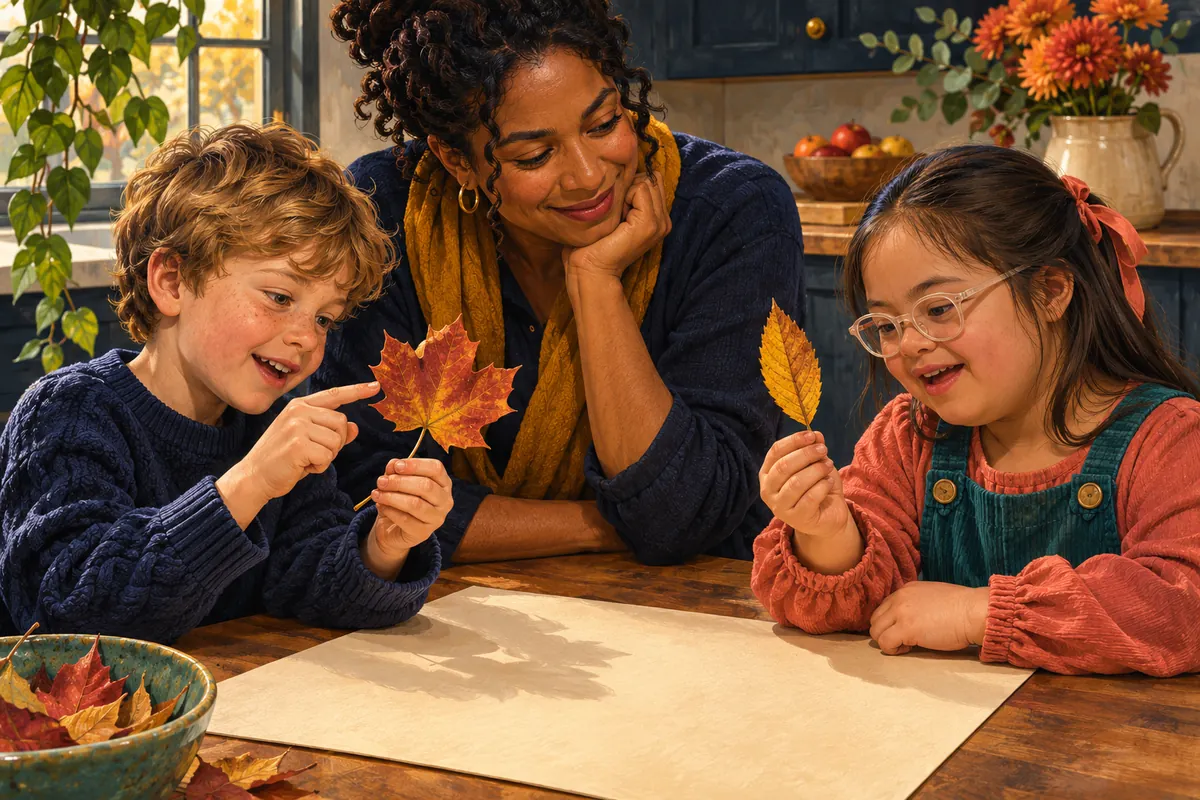
Place just two leaves on the mat. Say, “What is the same? What is different?” Give children time to look before adding more questions. If that invitation is too broad, model one observation: “This edge looks smooth. This edge has points.” Show the exact part you mean. Introduce the word edge beside the object rather than expecting children to infer it from your instructions.
A child might point to a brown patch or show you that one stalk is longer. Try saying back what you think they’re showing you and leave room for them to tell you if you’ve got it wrong.
Choose a feature you can check together: outline, edge, size or visible markings. Colour can be one option, but it should not be the only route into the task. Make the contrast clear through shape or position as well, and describe what is visible aloud when that helps. Different access needs call for different materials, rather than a universal SEND version.
2. Agree one rule and try it
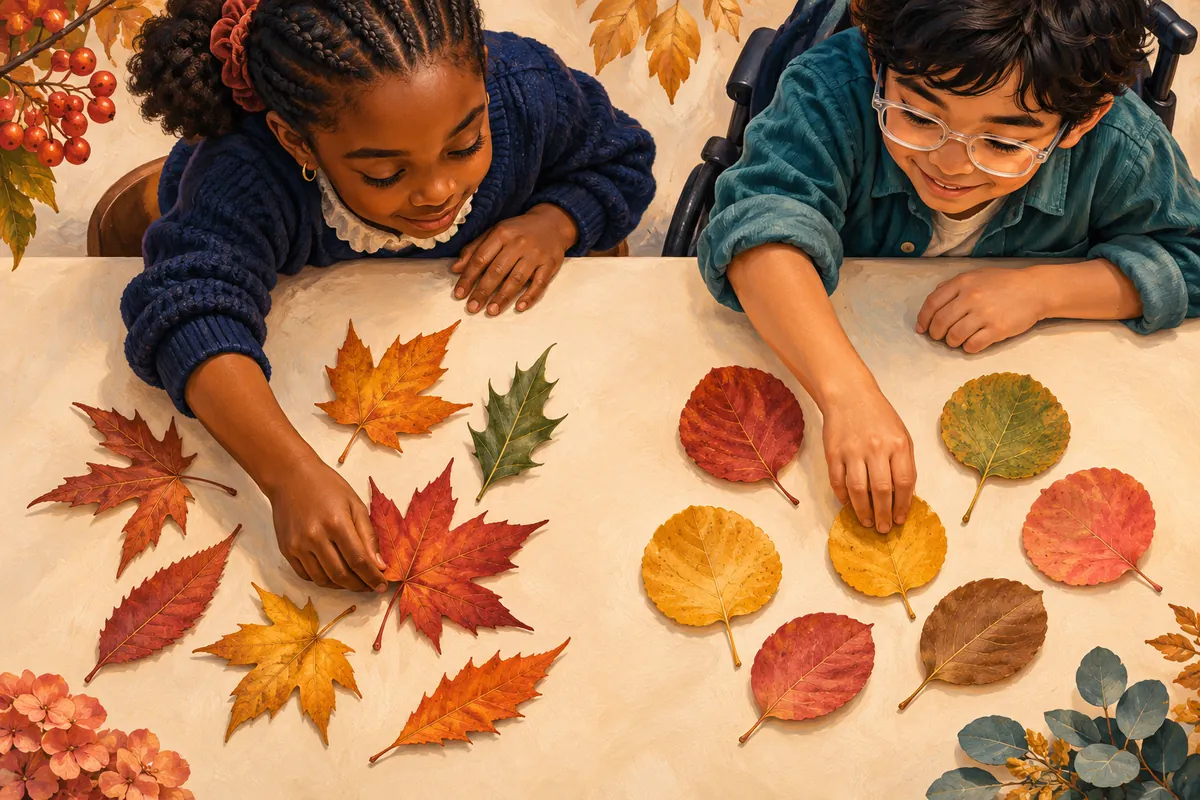
Offer a simple rule such as “pointed edges here; smoother edges there”. Put one example in each place and explain your decision. Then invite the child to place a third leaf, direct an adult where to put it, or indicate a choice through their established communication method. Keep the two examples visible so the rule does not have to be remembered entirely from speech.
Use only one rule at first. Sorting by colour, size and shape simultaneously can make it unclear which feature somebody is using. If a pupil groups all the large leaves together after you modelled edge shape, ask what they noticed. They may have found a coherent alternative rule. You can acknowledge it and then decide together which rule this round will test.
Leave a place for leaves you’re unsure about. A damaged edge can make it hard to tell. Ask what you could look at more closely, or see if the leaf is easier to place using another rule.
3. Change the rule and notice what moves
Photograph or briefly describe the first arrangement, if appropriate under your setting’s arrangements. Then gather the same leaves and propose a new rule. Instead of looking at edges, compare length. Place a short example and a longer example side by side, with their bases aligned. Decide a practical comparison together; you do not need an exact measurement in millimetres to begin noticing differences.
Ask which leaves moved when you changed the rule. You could say, ‘We were looking at edges before. Now we’re looking at length. Can you show me a leaf that goes somewhere different?’
For a further challenge, let a partner guess the sorting rule and explain the evidence. Keep this friendly and brief; it is an invitation to reason, not a trick. An older pupil might invent a rule that includes all the leaves except one, or find two possible rules for the same arrangement. Ask them to test their suggestion with a new specimen.
4. Record one finding in a useful way
Offer a record with three prompts: We looked at… / Our rule was… / This one made us think because… A child might draw two outlines and circle the edge they compared. Another might dictate a sentence, choose a photograph, or use their familiar communication system to explain. Record the adult support provided so that a carefully scribed response is not mistaken for independent writing.
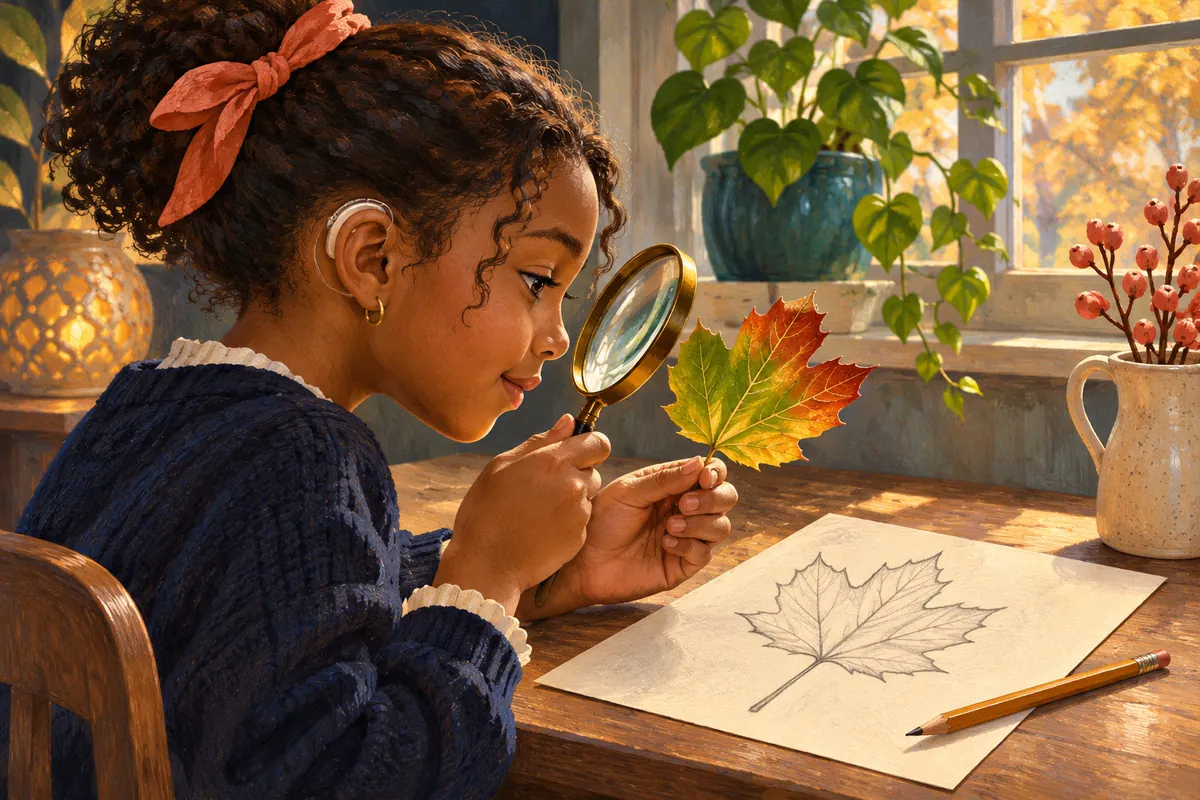
A quick drawing can help someone look closely, but it is not an art competition. If drawing creates an extra barrier, use a photograph of the arrangement or let the child point while you describe it. Keep the scientific decision visible. “Put this here” becomes more informative when you also know whether the child was comparing the outline, the stalk or the colour.
For a teacher or SENCO, a note such as “Used the example leaf to apply the edge rule; needed the rule shown again when it changed” gives a concrete next step. “Completed leaf activity” tells you much less. At home, you may need no written record at all: a short conversation about what changed can be enough to finish.
Adapt the session without losing its purpose
If the table feels busy, begin with two specimens and keep the rest out of sight. If reaching is difficult, put the tray within comfortable reach or let an adult move objects at the child’s direction. If a child uses AAC, allow time to locate their response and use the system they already know. A generic picture choice is not automatically a replacement for it.
If leaf handling is uncomfortable, offer photographs, observation without touch or a partner who handles the objects. Do not turn the task into a test of tolerating wet or crumbly textures. A pupil can make a thoughtful classification without touching a leaf. For more participation ideas, see our inclusive classroom communication guide.
If attention drifts, complete a single comparison and finish. On another day, introduce one new leaf rather than repeating every stage. If a child finds the question easy, ask them to justify an exception or choose the clearest examples for a younger learner. More writing is not the only way to add challenge.
Common questions about autumn leaf activities
Do we need to identify every tree?
No. This session compares visible features. If you want to name a tree afterwards, check a reliable identification source and the actual tree, not just a generated picture or an isolated damaged leaf. Keep “these look similar” separate from “these came from the same species”. You can leave an identification question open while still completing a useful sorting activity.
Can we use paper leaves?
Yes, for practising a sorting rule, if their differences are clear. Explain that you made the shapes. Paper models do not show natural variation, real texture or what is changing outdoors. If your question concerns plants or seasonal observation, return to actual specimens or suitable photographs rather than treating the model as evidence.
What if we cannot go outdoors?
Bring a small adult-selected collection inside or use photographs. You can also return to one view from a window on different days and describe what is visible. A single tray of fallen leaves does not tell you everything about the season. Keep any follow-up question tied to what children can genuinely observe.
Choose a follow-up that fits your group
The existing Explore membership lists ten activities, including leaf sorting and observation, with teacher guidance. Inspect its current preview and access information before choosing it. The session on this page is an additional original suggestion; it does not reproduce the pack’s instructions or claim to be its printer-friendly companion.
For another practical investigation, try our inclusive sink-or-float activity. For a change of direction, make an imaginary island turns attention towards a newly invented place. Browse creative activities or compare current membership options when you want to check which materials suit your family or setting. Start with a question the child wants to explore; an ordinary leaf is enough for today.
Source and illustration notes
Curriculum context: Department for Education, England science programmes of study, updated 6 May 2015; linked above and checked 7 November 2026. The activity, timings and adaptations are editorial teaching suggestions, not a clinical programme or evidence of a product’s measured effectiveness. Editorial images are AI-generated illustrative scenes, not photographs of real school use or botanical identification references.